
Company
How Cal.com Rebuilt AppSec After Going Closed Source
How Cal.com consolidated noisy security tooling into one continuous, context-aware pull request security program with Gecko.
Gecko Security
 Gecko Security13 min read
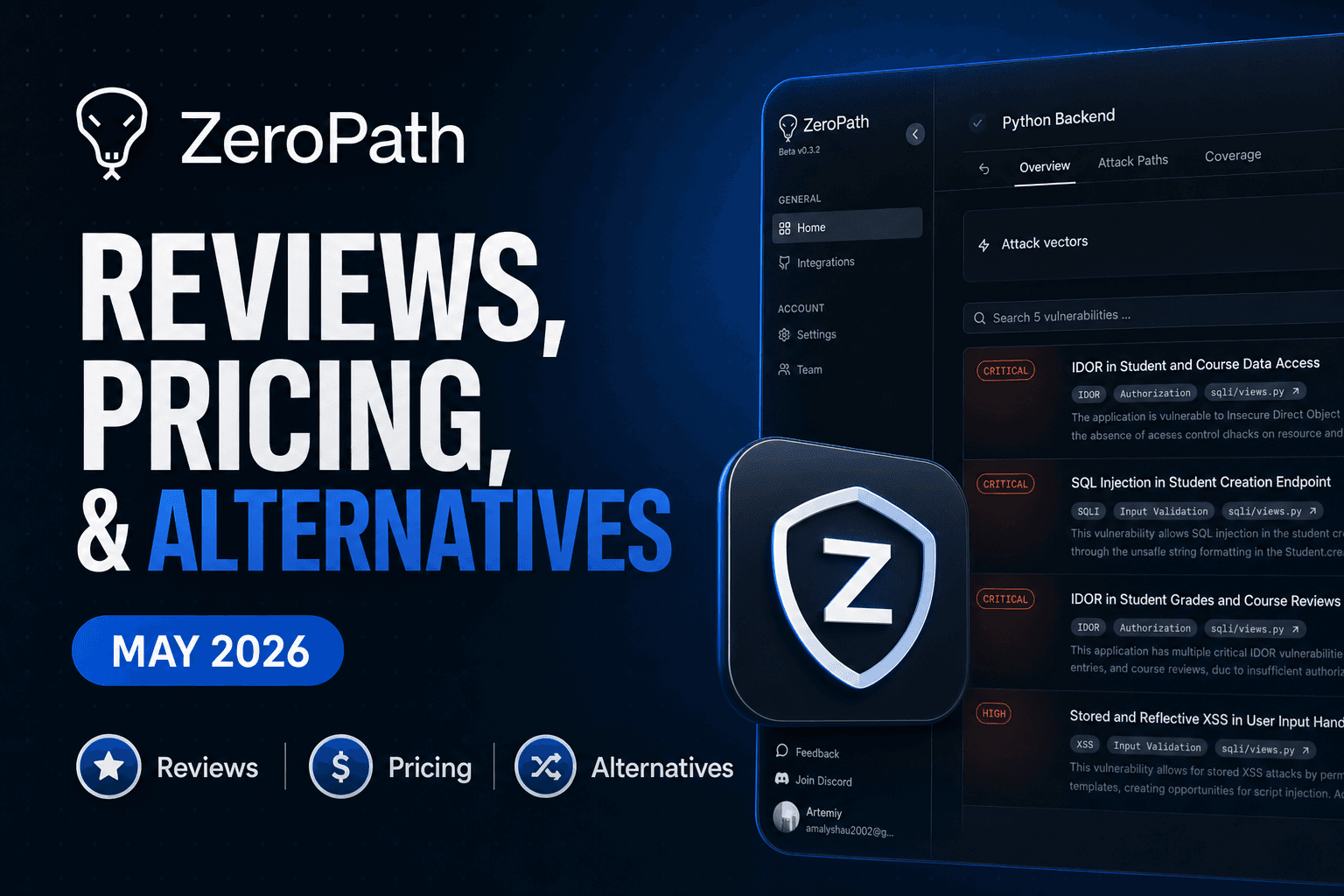
When you're comparing ZeroPath alternatives, the differentiator isn't language support or scan speed. It's whether the tool reasons about your code the way an attacker does: tracing call chains across files, weighing exploitability against actual infrastructure, and catching authorization logic that breaks only when three services interact in a specific sequence. Most static analysis tools, ZeroPath included, operate at the file level and treat every vulnerability as equally severe regardless of where it's deployed or whether it's even reachable from outside your network. If you're spending more time triaging noise than fixing real exposures, that's the structural limitation showing up. The tools and ZeroPath reviews below clarify which platforms actually close that gap and which ones that just repackage the same single-file detection model with better marketing.
TLDR:
ZeroPath is an AI-powered application security tool built to find vulnerabilities through automated scanning and static analysis, targeting development teams that want security coverage without heavy security engineering overhead.
ZeroPath combines static analysis with AI-assisted reasoning to scan source code for common vulnerability classes. Its workflow generally follows this pattern:
The tool aims to sit inline with developer workflows so that security feedback arrives before code ships to production.
ZeroPath targets the category of problems that traditional SAST tools have long struggled with: high false positive rates and findings that developers struggle to act on without deep security context. By incorporating AI into the triage and analysis layer, it attempts to make results more actionable.
The tool supports common vulnerability categories including injection flaws, authentication issues, and insecure dependencies. It is positioned for teams that want automated security coverage without dedicating substantial security engineering time to tuning rules or reviewing noisy scan output.
ZeroPath delivers solid AI-assisted vulnerability detection, but several structural limitations push security teams to look elsewhere. Research on static analysis warnings shows that specific vulnerability types produce higher false positive rates, a challenge that persists across the category.
Here are the most common reasons teams start comparing alternatives:
If any of these gaps appear in your current workflow, the tools below are worth a close look.
Gecko is an AI-native application security tool that reasons over a compiler-accurate semantic graph of your codebase instead of matching patterns against syntax trees. Every finding ships with a working proof-of-concept exploit, so triage time drops because the exploitability question is already answered.
Where ZeroPath stops at the file or service boundary, Gecko traces vulnerabilities across call chains, trust boundaries, and service-to-service interactions. It pulls in context from outside the code (infrastructure configuration, deployment environment, access control models) so risk is weighted by actual exposure instead of code structure alone.
Gecko also integrates directly into the PR review cycle with auto-generated fix suggestions and configurable merge-blocking, removing the need for bolt-on tooling to enforce security gates. For teams dealing with business logic flaws, broken access control, or multi-service auth issues, that architectural difference is where most of the value shows up.
ZeroPath covers the core SAST workflow reasonably well, but several teams find gaps once they need deeper context, broader language support, or more transparent remediation reasoning. The alternatives below each approach application security from a distinct angle.
Gecko Security is an AI-native AppSec tool built around a compiler-accurate semantic graph rather than pattern matching. Where ZeroPath flags issues at the file or function level, Gecko traces vulnerabilities across service boundaries, call chains, and trust boundaries that span multiple files and services.
The core difference is how findings are delivered. Every Gecko result ships with a working proof-of-concept exploit, so developers see exactly what an attacker could do—beyond where a weakness exists. Fixes are generated with the same semantic understanding used to detect the issue, which reduces the back-and-forth between security and engineering.
Gecko also pulls in context outside the code itself: infrastructure configs, deployment environment, and access control models factor into how risk is weighted. A vulnerability in an internal service behind a VPN carries different weight than the same pattern exposed on a public API endpoint. ZeroPath, like most SAST tools, treats those patterns identically.
For teams running CI/CD pipelines, Gecko integrates at the PR level with auto-remediation and merge-blocking under team control. Findings are ranked by exploitability over severity label, which cuts the noise that makes most SAST alert queues unworkable.
Semgrep is a widely used static analysis tool with a large rule library and strong IDE and CI integrations. It operates at the file level using pattern-based rules, which makes it fast and configurable but limits its ability to trace issues across service or module boundaries. Teams comfortable writing custom rules get good coverage for known vulnerability classes. Cross-service logic flaws and business logic issues fall outside what pattern matching can catch.
Snyk is best positioned as a dependency and supply-chain security tool. It scans package manifests, lock files, and container images against a continuously updated vulnerability database, surfacing CVEs with fix guidance attached. License compliance scanning is included, which matters for teams shipping software with strict open-source policy requirements.
Where Snyk earns its place is the third-party dependency surface: it catches vulnerable versions of npm, PyPI, Maven, and Go modules at the point where a developer adds or upgrades a package, well before the dependency reaches production. It integrates into GitHub, GitLab, and Bitbucket PRs with automated fix suggestions that open upgrade PRs directly.
The scope ends there. Snyk does not analyze custom application code, does not trace authorization logic through call chains, and does not reason about whether a CVE in a dependency is actually reachable from your application entry points. Teams typically run it alongside a SAST tool — covering the dependency layer — instead of in place of one.
Endor Labs focuses on reachability analysis for open-source dependencies, filtering out vulnerabilities in packages where the vulnerable code path is never actually called. Where a tool like Snyk flags every package version matching a CVE, Endor Labs traces whether your application code actually invokes the vulnerable function — and suppresses findings where it does not. In a large codebase with hundreds of transitive dependencies, that distinction cuts dependency alert volume sharply without requiring manual triage rules.
The tradeoff is scope. Endor Labs reasons about the dependency graph and call paths into third-party libraries. It does not analyze custom application code, authorization logic, or cross-service interactions. Teams that need coverage for both dependency risk and first-party vulnerabilities will use it alongside a SAST tool, not in place of one.
ZeroPath is an AI-driven application security tool built around automated vulnerability detection and remediation. It targets development teams looking to catch security issues earlier in the software development lifecycle without relying heavily on manual review.
ZeroPath supports several mainstream languages and connects to common source control providers. GitHub integration is the most referenced in user feedback, with GitLab and Bitbucket listed as supported targets. Language coverage spans JavaScript, TypeScript, Python, Go, Java, and Ruby, which covers the majority of web application codebases teams bring to the tool.
ZeroPath positions itself as a developer-first security tool, with the goal of keeping security feedback close to where code is written. The focus is on speed of detection and fix suggestion generation, with less emphasis on deep semantic reasoning across service boundaries or business logic correctness.
ZeroPath supports over 30 programming languages, covering the major stacks most teams ship: Python, JavaScript, TypeScript, Go, Java, Ruby, PHP, Rust, C, and C++. Most static analysis tools in this category focus narrowly on one or two languages or bolt on support as an afterthought, leaving inconsistent coverage across mixed codebases.
Broad language support lets a single tool run across a polyglot repo without separate scanners per service. That said, language breadth and analysis depth are different things. A tool can parse 30 languages while still operating at the syntactic level, flagging patterns without tracing how data moves across service boundaries or resolving types through dynamic dispatch.
Semgrep's detection covers SQL injection, XSS, authentication bypasses, and secret exposure, backed by a large community rule library.
It works well for injection and compliance scanning, fast CI/CD integration, open-source projects needing free tooling, and engineers writing custom rules for known patterns. The structural limit is that single-file analysis cannot trace bugs spanning services, and pattern matching cannot evaluate whether authorization logic is correct for your specific application.
ZeroPath is an AI-powered application security tool built around autonomous security agents. It positions itself as a way to move beyond static rule-based scanning by using agents to reason about vulnerabilities instead of matching patterns.
ZeroPath's core claim is that its agents reduce false positives by validating exploitability before surfacing a finding. The idea is that a finding only reaches the developer if the agent has confirmed a plausible attack path, which cuts noise compared to traditional SAST tools that flag any pattern match regardless of context.
The tool targets developer-first workflows, meaning findings are surfaced at the point where a developer is already reviewing code, not in a separate security console requiring context-switching.
Nullify.ai combines SAST, SCA, DAST, and secrets scanning across application code, dependencies, and runtime exposure.
Core capabilities:
It fits teams with thorough, current documentation and threat models. The structural limit appears when code moves faster than docs. When that gap opens, the tool reasons on stale context, and authorization bypasses that were never written into a design doc stay invisible.
Gecko indexes code directly instead, starting from how the code actually behaves instead of how it was documented.
The tools in this category differ more in architecture than feature checklists suggest, but a direct comparison helps clarify where each one actually fits.
| Capability | ZeroPath | Gecko Security | Snyk | Semgrep | DryRun Security | Nullify.ai |
|---|---|---|---|---|---|---|
| Business Logic Detection | Yes | Yes (primary focus) | No | No | Yes | Yes |
| Cross-Service Analysis | No | Yes | No | No | Limited (PR context) | Limited |
| Infrastructure Context | No | Yes (Wiz integration) | No | No | No | Yes (cloud reachability) |
| Proof-of-Concept Generation | Yes | Yes (automatic exploit chains) | No | No | No | Yes (exploit validation) |
| Dependency Scanning (SCA) | Yes | Yes | Yes (primary strength) | Yes | No | Yes |
| Secrets Detection | Yes | Yes | No | Yes | Yes | Yes |
| IaC Scanning | Yes | No | Yes | No | No | Yes |
| Automated Fix PRs | Yes | Yes | Yes | No | Yes | Yes |
| False Positive Rate | 75% reduction | 50% fewer false positives | Standard | Standard with AI Assistant | Low (contextual analysis) | Low (triage) |
| PR Review Integration | Yes | Yes | Yes | Yes | Yes (primary mode) | Yes |
Cross-service analysis and infrastructure context are the clearest dividing lines in this table. Most tools handle individual repos and known patterns reasonably well. Where the field narrows is tracing a vulnerability across service boundaries, weighting it by actual deployment exposure, and generating a PoC that proves exploitability before the finding ever reaches a developer's queue. ZeroPath handles the PoC side, but stops at the service boundary. Snyk owns dependency scanning but does not reason about application logic. Gecko's separation comes from combining cross-service tracing with compiler-accurate semantic analysis and external context, so findings arrive with proof of exploitability and a risk weight tied to real infrastructure, beyond code patterns alone.
Gecko Security takes a fundamentally different approach to application security than ZeroPath. Where ZeroPath focuses on agentic AI-driven remediation layered on top of existing SAST signals, Gecko builds its findings from a compiler-accurate semantic graph that reasons across files, services, and trust boundaries instead of pattern-matching within them.
Every finding Gecko produces includes a working proof-of-concept exploit. The detection engine reasons over inter-procedural call chains and tracks taint across service boundaries, so vulnerabilities that span multiple files or cross an API boundary are visible in the same way single-file issues are. ZeroPath's remediation layer is only as good as the signals it receives upstream. If the underlying scanner misses a cross-service authorization flaw, the agentic fix layer never sees it.
Gecko also ingests context that lives outside source code entirely: infrastructure configs, deployment topology, and trust model details. A SQL injection in an internal service behind a VPN carries different risk than the same pattern exposed on a public endpoint. Gecko weights findings accordingly. ZeroPath does not surface this kind of risk differentiation in its reported results.
If you are already using ZeroPath and finding that its remediation suggestions frequently target the wrong root cause, or that cross-service vulnerabilities slip through, those are structural gaps that a different remediation layer cannot close. The detection model itself has to change.
ZeroPath handles straightforward detection and fix generation reasonably well, but it stops where most real security work begins: at the service boundary, at the question of whether a flaw is actually exploitable in your environment, at the point where code correctness matters more than pattern matching. If your current tool misses cross-service issues or buries real vulnerabilities under noise, the constraint isn't tuning—it's the model. Schedule 30 minutes if you want to see how Gecko traces vulnerabilities the way an attacker would.
Teams typically look for alternatives when they need cross-service vulnerability tracing, deployment-context risk prioritization, or deeper analysis of business logic flaws that span service boundaries—capabilities that require reasoning beyond individual files or repositories.
Consider switching if vulnerabilities regularly slip through that your penetration testers later find, if you need to weight risk by actual infrastructure exposure instead of code-level severity scores, or if your architecture spans multiple services where authorization logic crosses trust boundaries.
Look for cross-repository analysis that traces call chains through shared libraries, proof-of-concept generation that validates exploitability before findings reach your queue, and infrastructure-context integration that weights findings by deployment topology and real attack surface.
Compiler-accurate semantic analysis resolves types and call chains the way IDEs do, preserving relationships across files and services, while pattern matching flags syntactic structures without understanding whether authorization logic is correct or whether a finding is exploitable in your actual deployment.
AI-powered tools reduce false positives by validating exploitability through semantic reasoning over call chains and data flows, not by filtering pattern-match results. The reduction comes from understanding whether a vulnerability is reachable and exploitable in your actual codebase, which requires tracing across service boundaries and resolving types through runtime dispatch.
Gecko Security
The latest news, technologies, and resources from our team.
How Cal.com consolidated noisy security tooling into one continuous, context-aware pull request security program with Gecko.
Gecko Security
See what actually changed in the OWASP Top 10 for 2026, from merged SSRF and XXE categories to new supply chain risks and scanner coverage gaps.

Jeevan Jutla
Gecko Security uncovered CVE-2026-21894 in August 2026, an n8n authorization bypass with CVSS 8.8. See why static tools missed it and how to remediate it.
Jeevan Jutla
Security misconfiguration is OWASP A05 for a reason. Learn how deployment context determines exploitability and how to fix gaps in August 2026.
Jeevan Jutla
How do modern AppSec vendors actually compare? This July 2026 capability map covers SAST, DAST, SCA, business logic flaws, and cross-service
Gecko Security
Break down your AppSec stack: what SAST, DAST, SCA, IAST, and pen testing each see — and what they miss. Updated July 2026 by Gecko Security.
Gecko Security
Occasional updates, new content, and insights. No spam; unsubscribe anytime.




