
Company
How Cal.com Rebuilt AppSec After Going Closed Source
How Cal.com consolidated noisy security tooling into one continuous, context-aware pull request security program with Gecko.
Gecko Security
 Gecko Security9 min read
Looking through best SAST tools lists usually means scrolling past the same names with incrementally different feature matrices, but the real question isn't which tool supports the most languages. It's which one catches authorization bypass across microservices, business logic errors that require semantic reasoning, and auth gaps that traditional pattern matching can't see. We built this ranking around those capabilities because preventing production incidents requires more than flagging known patterns in isolated files.
TLDR:
SAST tools scan source code, bytecode, or compiled binaries without executing the application. By analyzing code statically, they catch security flaws before anything ships to production, making them a first line of defense in any development pipeline. Unlike runtime testing that requires a running application, static analysis works on raw code, which means you can integrate it directly into your development workflow and catch issues during code review instead of after deployment.
The case for automated scanning is stronger than ever. AI-generated code introduces security flaws in 45% of cases, which means vulnerable code is reaching production faster than any team can manual review. SAST scales where human review simply can't. Traditional manual code review catches obvious mistakes, but tracing data flow across dozens of files or spotting authorization gaps in microservice architectures requires automation that can reason about code structure, control flow, and data dependencies simultaneously.
Most SAST tools work by parsing your codebase into an abstract syntax tree, then applying rules or analysis engines to identify patterns that match known vulnerability signatures. The difference between a useful tool and one that generates noise comes down to how well it understands context: whether it can distinguish between a SQL query that's actually vulnerable versus one that's already parameterized, or whether it recognizes that user input hitting a particular function actually represents a security boundary worth flagging.
The criteria here aren't theoretical. We focused on what causes vulnerabilities to slip through to production, not what looks good in a feature matrix.
We ranked each tool across six dimensions:
Rankings draw from vendor documentation, publicly available security research, and independent testing. A long feature list didn't guarantee a high rank. Real-world detection capability for complex vulnerability classes like broken access control and auth bypass carried the most weight.
Gecko Security sits at the top of this list for one reason: it goes beyond what traditional SAST tools do.
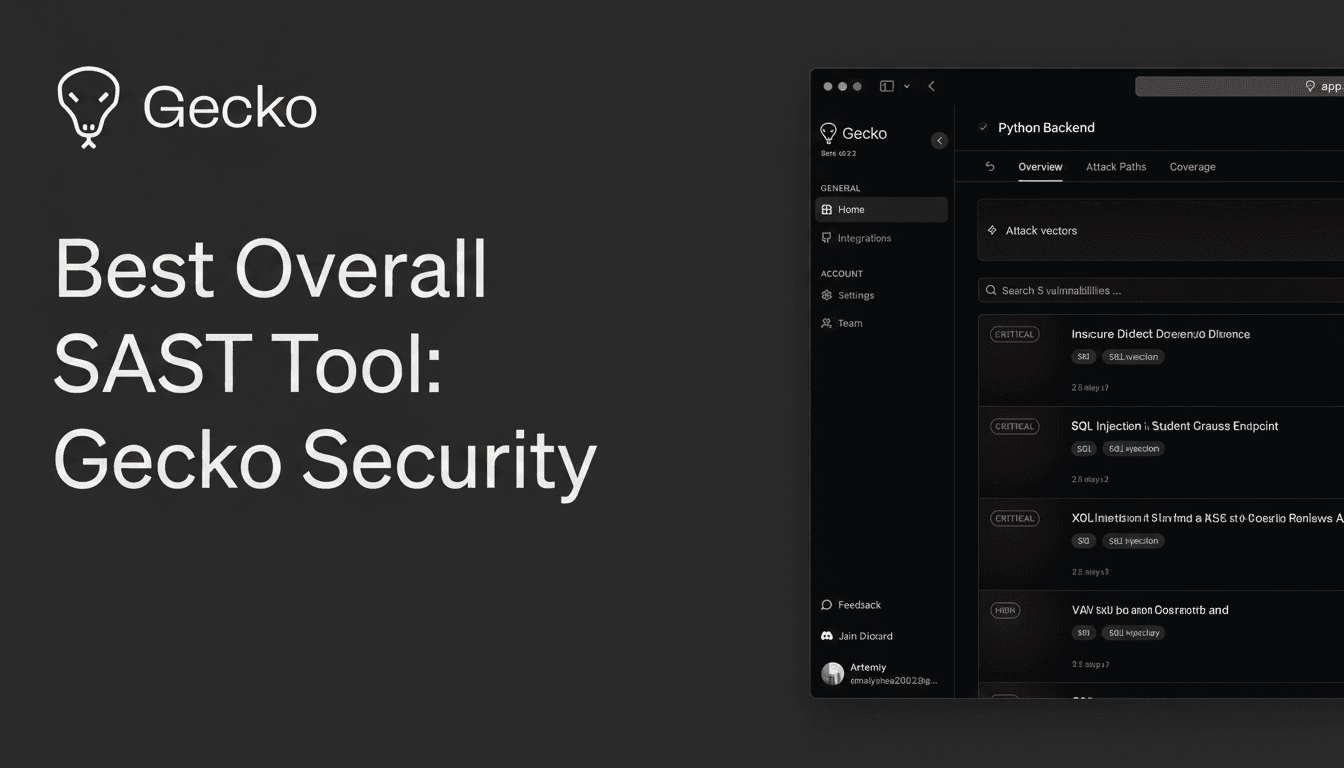
Most SAST tools parse files, flag patterns, and generate reports. Gecko goes deeper, running AI-powered security audits that reason across your entire codebase to find vulnerabilities that file-by-file scanners consistently miss. Think inter-procedural taint flows, authentication gaps, and logic flaws that only surface when you trace execution paths across multiple services. Static code analysis at this level delivers actionable, context-aware reports built for developers who need to fix issues, not simply review them.
Where other tools hand you a CSV of findings, Gecko delivers actionable, context-aware reports built for developers who need to fix issues, not simply review them.
Snyk is a developer-focused security tool that covers SAST, SCA, and container scanning in a single product. It integrates directly into IDEs, CI/CD pipelines, and source control workflows, making it popular with engineering teams that want security checks embedded in day-to-day development instead of bolted on at the end.
The free tier supports open source projects and individual developers, while paid plans unlock deeper scanning, reporting, and policy controls for larger teams. Understanding SAST vs DAST helps teams choose the right testing approach.
Semgrep is a widely adopted open source SAST tool that uses pattern-based rules to catch security bugs across dozens of languages. Teams write rules in YAML that mirror code syntax directly, making it approachable for engineers who want to encode custom security policies without learning a full query language.
Where Semgrep excels is speed and extensibility. Its rule registry covers common vulnerability classes out of the box, and the community contributes patterns constantly. The tradeoff is depth: cross-file dataflow analysis remains limited in the open source version, meaning complex injection paths that span multiple modules can slip through.
Endor Labs combines SAST, SCA, container scanning, secrets detection, and malware detection into one product. Its standout feature is function-level reachability analysis, which filters out vulnerabilities in code paths your application never actually executes.
That filtering has real numbers behind it: up to 97% alert noise reduction and 95% fewer false positives in comparative testing. Coverage spans 40+ languages and traces vulnerability history back to 2005, which matters for teams inheriting old codebases.
The limitation worth knowing: Endor Labs is fundamentally a dependency security tool with SAST added on. It analyzes one repository at a time, so cross-repository authorization bypass tracing across microservices falls outside its scope. Reachability analysis works well for filtering known CVEs in third-party dependencies, but finding novel business logic flaws in your own first-party code requires a different approach entirely.
Good for teams drowning in SCA noise. Less suited for finding unknown logic vulnerabilities across distributed services.
DryRun Security is a GitHub app that analyzes code changes during pull requests, checking authentication, authorization, sensitive code paths, and code brittleness in real-time.
Here's what they offer:
Good for teams wanting contextual PR-level feedback integrated directly into GitHub without writing complex rule sets.
The limitation is scope. DryRun catches what's coming in through new PRs but doesn't surface what already exists across a production codebase. Cross-repository semantic analysis isn't supported, so vulnerabilities spanning microservices stay hidden. Prevention and discovery are different problems, and most organizations need both.
SonarQube is one of the most widely deployed SAST tools in enterprise environments, known for its broad language support and deep integration with CI/CD pipelines. It scans source code for bugs, vulnerabilities, and code quality issues across 30+ programming languages.
The free Community Edition covers core static analysis, while paid tiers unlock security-focused rules, branch analysis, and portfolio reporting. Teams testing out free SAST tools often start here before hitting the paywalled features they actually need.
Checkmarx SAST is an enterprise-grade source code analysis tool covering security vulnerabilities, compliance issues, and business logic problems across a broad range of languages.
Here is what they offer:
Good for large enterprises with dedicated AppSec teams needing centralized governance and compliance reporting across multiple testing types.
The limitation is complexity. Smaller teams may find the overhead more than they need. False positive rates run high on large codebases, and the query-based engine still struggles with business logic vulnerabilities that require semantic reasoning across service boundaries. Coverage breadth and signal quality are different things, and Checkmarx trades the latter for the former.
Veracode has been in the SAST space for over 20 years and holds Forrester Wave Leader status with 9 perfect scores, the only vendor to score perfectly across all remediation categories.
Here is what they offer:
Good for enterprises managing legacy codebases up to 5GB, especially where source code access is limited and binary analysis is a requirement.
The limitation is familiar: Veracode's deterministic approach analyzes code structure and data flow, but cannot reason about whether your authorization logic is correct for your specific permission model, or trace semantic flaws across microservice boundaries. Business logic errors require understanding what your application is supposed to do, and that falls outside what pattern-based engines can answer.
Here's how the tools stack up across the features that matter most for real-world security coverage.
| Feature | Gecko Security | Snyk | Semgrep | Endor Labs | DryRun Security | SonarQube | Checkmarx | Veracode |
|---|---|---|---|---|---|---|---|---|
| Business Logic Detection | Yes | No | No | Limited | Yes | No | Limited | No |
| Cross-Repository Analysis | Yes | No | No | No | No | No | No | No |
| Proof-of-Concept Generation | Yes | No | No | No | No | No | No | No |
| AI-Native Semantic Reasoning | Yes | No | No | Limited | Yes | No | No | No |
| Infrastructure Context Integration | Yes | No | No | No | No | No | No | No |
| Microservice Boundary Tracing | Yes | No | No | No | No | No | No | No |
| GitHub PR Integration | Yes | Yes | Yes | Yes | Yes | Yes | Yes | Yes |
| Custom Rule Support | No | No | Yes | No | Yes | Limited | Yes | No |
| Free Tier Available | Yes | Yes | Yes | No | No | Yes | No | No |
| SCA (Dependency Scanning) | No | Yes | Yes | Yes | No | Yes | Yes | Yes |
| False Positive Rate | 50% lower | Standard | Standard | Very Low | Low | Standard | High | Very Low |
Gecko Security takes a fundamentally different approach to application security testing. Where traditional SAST tools rely on pattern matching and rule-based scanning, Gecko uses AI agents that reason across your entire codebase the way a skilled security engineer would.
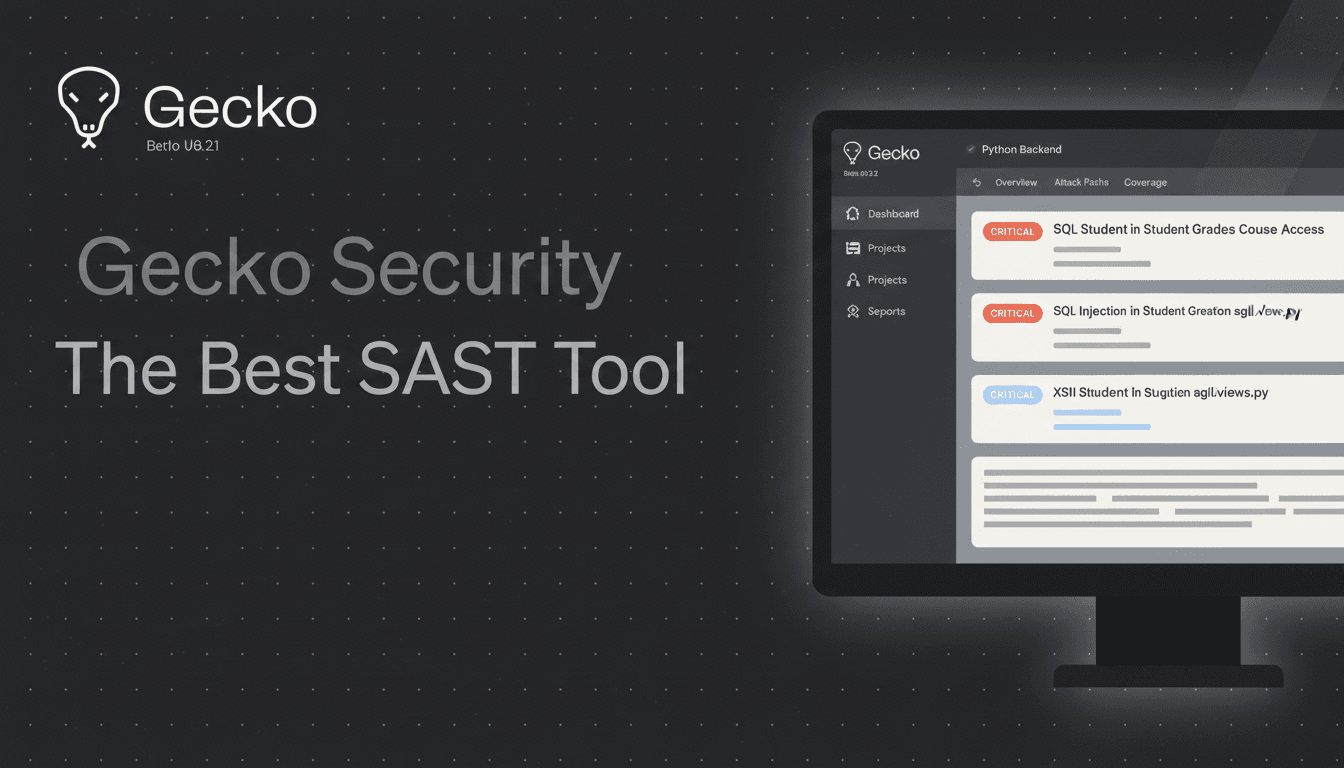
The result is fewer false positives, deeper vulnerability detection, and findings that actually make sense in context. Gecko catches what static rules miss: multi-file data flows, business logic flaws, and authentication gaps that only surface when you understand how code behaves end-to-end.
Key capabilities include:
Best SAST tools are the ones that find vulnerabilities before they ship, not the ones with the longest feature lists. Your security team needs findings that trace across microservices and actually explain what's broken in context developers understand. If you want to see what AI-native detection looks like on your codebase, grab 30 minutes here. Single-file analysis solves yesterday's problems, but production breaches come from logic flaws that span multiple services and repositories.
Start by identifying your biggest pain point: high false positives, missing business logic flaws, or limited coverage across microservices. If you're drowning in noise from traditional pattern-matching tools, focus on semantic analysis capabilities. If you need cross-repository scanning for distributed systems, look for tools that reason beyond single-file analysis.
Gecko Security and DryRun Security specialize in business logic detection through AI-powered reasoning, while traditional options like Checkmarx, Veracode, and Semgrep focus primarily on syntactic vulnerabilities like SQL injection and XSS. For authorization bypass, broken access control, and privilege escalation flaws, you need a tool that understands intent and correctness, not merely code structure.
Free tools like Semgrep, SonarQube Community Edition, and Snyk's open source tier handle common vulnerability patterns well, but they miss semantic flaws that span multiple files or services. If your codebase is simple and monolithic, free tools provide solid baseline coverage. For microservice architectures or complex authorization logic, you'll need commercial-grade semantic analysis.
Traditional SAST tools match code against predefined patterns: they find what you tell them to look for. AI-native tools like Gecko reason about what your code is supposed to do and trace execution flows across your entire system. The difference shows up in false positive rates and the ability to catch novel business logic flaws that don't match known patterns.
Run SAST during development to catch vulnerabilities before code ships, use SCA to identify risky dependencies in your supply chain, and layer DAST on deployed applications to test runtime behavior. Most teams need all three, but if you're starting from scratch, SAST delivers the highest return by catching flaws while they're cheapest to fix.
Gecko Security
The latest news, technologies, and resources from our team.
How Cal.com consolidated noisy security tooling into one continuous, context-aware pull request security program with Gecko.
Gecko Security
See what actually changed in the OWASP Top 10 for 2026, from merged SSRF and XXE categories to new supply chain risks and scanner coverage gaps.

Jeevan Jutla
Gecko Security uncovered CVE-2026-21894 in August 2026, an n8n authorization bypass with CVSS 8.8. See why static tools missed it and how to remediate it.
Jeevan Jutla
Security misconfiguration is OWASP A05 for a reason. Learn how deployment context determines exploitability and how to fix gaps in August 2026.
Jeevan Jutla
How do modern AppSec vendors actually compare? This July 2026 capability map covers SAST, DAST, SCA, business logic flaws, and cross-service
Gecko Security
Break down your AppSec stack: what SAST, DAST, SCA, IAST, and pen testing each see — and what they miss. Updated July 2026 by Gecko Security.
Gecko Security
Occasional updates, new content, and insights. No spam; unsubscribe anytime.




