
Company
How Cal.com Rebuilt AppSec After Going Closed Source
How Cal.com consolidated noisy security tooling into one continuous, context-aware pull request security program with Gecko.
Gecko Security
 Gecko Security10 min read
You're comparing Nullify pricing and reading Nullify reviews because your security backlog is full of findings you can't confidently act on, and you need a tool that narrows the gap between detection and remediation. Nullify positions itself as AI-assisted SAST that filters false positives and generates fix suggestions developers can use without deep security expertise. That works well when the vulnerability fits a known pattern the AI has seen before. It breaks down when the issue involves business logic across multiple services, or when you need to know whether a flagged SQL injection is actually reachable given your infrastructure. The limitation isn't unique to Nullify. Most AI security tools in this space reason over individual files, match against learned patterns, and lack visibility into runtime context or deployment topology. If you're finding that Nullify alternatives all seem to hit the same ceiling, or that your team spends as much time validating findings as fixing them, the question to ask isn't which tool has better rules. The question is whether the tool can prove exploitability in your specific environment, or whether it's handing you a list and asking you to figure that part out yourself.
TLDR:
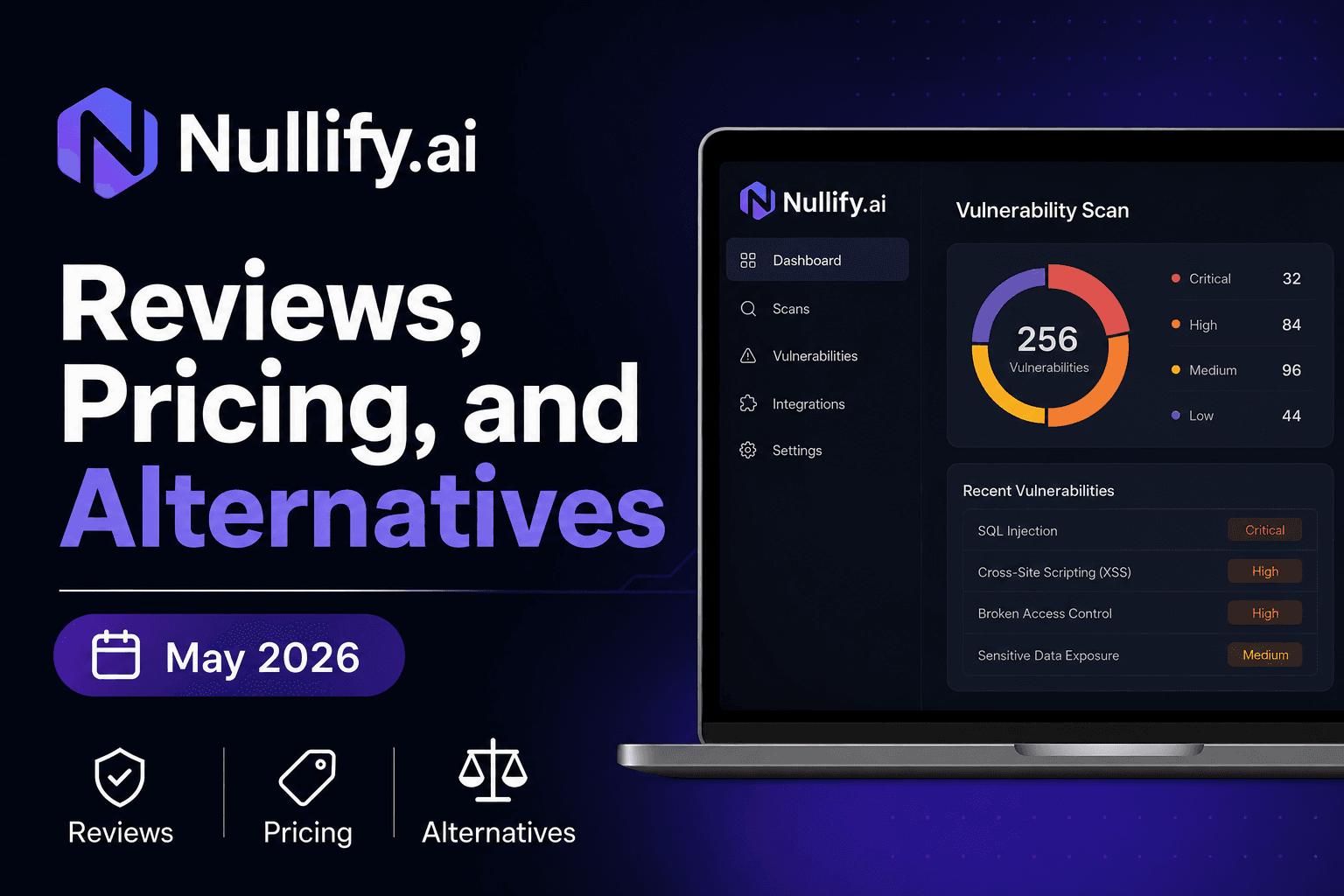
Nullify.ai is an AI-powered application security tool built to help development teams find and fix vulnerabilities faster. It sits in the SAST category but layers AI assistance on top of static analysis to reduce noise and accelerate remediation workflows.
The core workflow follows a familiar pattern: connect a repository, run a scan, and receive findings ranked by severity. Where Nullify sets itself apart is in how it processes those findings. Instead of returning a raw list of rule violations, it applies AI to group related issues, filter out likely false positives, and generate suggested fixes that developers can review and apply.
The tool targets teams that want to shift security left without dedicated AppSec headcount. The value proposition is reducing triage time and making findings actionable for developers who lack deep security expertise.
Nullify.ai fills a real gap: it brings AI-assisted vulnerability scanning into the development workflow and attempts to reduce the noise that plagues traditional SAST tools. For teams that have spent years triaging false positives from tools like Semgrep or Snyk, that value proposition is clear.
The friction shows up in a few recurring patterns across user feedback. Application vulnerabilities reached 6.29 billion in 2025, and teams working with traditional SAST tools spend most of that time triaging rather than fixing.
Coverage depth varies by language and framework. Teams working outside Nullify's strongest supported stacks report inconsistent results, particularly for complex inter-service vulnerabilities that require tracing logic across multiple files or services.
Business logic flaws remain out of reach. Nullify, like most SAST tools in this category, focuses on known vulnerability patterns. Bugs rooted in incorrect application behavior, broken access control across trust boundaries, or authorization failures that only appear in specific call chains tend to go undetected.
Remediation guidance quality is uneven. Some findings come with actionable fix suggestions; others surface the issue without enough context for a developer to act confidently. This inconsistency adds friction in high-velocity teams where engineers expect fix-ready output.
Pricing transparency is limited. Nullify does not publish detailed tier breakdowns publicly, which makes budget planning harder during vendor evaluation.
None of these are unique to Nullify. They reflect structural limits that apply across much of the AI-assisted SAST category: tools that reason over individual files, match against known patterns, and lack visibility into runtime context, infrastructure configuration, or design intent will consistently miss a class of vulnerabilities that matter.
Nullify.ai occupies a specific niche: automated security scanning with AI-assisted remediation guidance. Several tools compete in this space, each with different architectural tradeoffs worth understanding before committing to one.
Gecko Security is an AI-native application security tool built for security teams and developers who need findings that go beyond what pattern-matching SAST can produce. Where Nullify.ai surfaces vulnerabilities through automated scanning pipelines, Gecko reasons over a compiler-accurate semantic graph of your codebase, tracing vulnerabilities across files, services, and trust boundaries rather than within them.
The structural difference matters in practice. Nullify.ai can flag known vulnerability patterns. Gecko identifies whether a vulnerability is actually exploitable given your specific deployment context, then delivers a working proof-of-concept exploit alongside the finding. Every result includes a concrete fix, not a generic remediation suggestion.
Gecko has found 30+ CVEs in 8 months against real open-source codebases, including projects like Cal.com, ONYX, N8N, and Ollama. These are cross-service, business logic, and broken access control vulnerabilities that file-level scanners routinely miss.
Key differences from Nullify.ai:
If your team is triaging high false-positive volumes from Nullify.ai or finding that flagged issues lack exploitability evidence, Gecko is built to solve exactly that problem.
Semgrep is a widely used static analysis tool with a large open-source rule library and strong IDE and CI/CD integration. It operates at the file level using pattern-matching against an AST, which makes it fast and easy to customize with YAML rules.
The limitation is structural: Semgrep cannot trace data flow across service boundaries or reason about whether a finding is exploitable in context. It finds what matches its rules. For teams that need broad coverage of known patterns with fast feedback, Semgrep works well as a first pass. For teams dealing with complex authorization logic or multi-service vulnerabilities, it will miss the findings that matter most.
Snyk's core strength is dependency and supply-chain scanning, not application code analysis. It tracks vulnerable package versions, license issues, and container image vulnerabilities with strong ecosystem coverage across npm, PyPI, Maven, and others.
Snyk and Nullify.ai are not direct equivalents. If your primary concern is third-party dependency risk, Snyk handles that well. If your concern is vulnerabilities in your own application code, particularly business logic and access control flaws, Snyk is not designed for that job. Gecko and Snyk operate in complementary spaces rather than competing ones.
Snyk Code is Snyk's SAST offering, distinct from its dependency scanning. It provides real-time feedback in the IDE and integrates into CI pipelines. Like Semgrep, it operates primarily on a per-file or per-repository basis.
It covers common vulnerability classes well and has reasonable developer ergonomics. The same structural ceiling applies: cross-service taint tracking and exploitability reasoning are outside what it does.
GHAS bundles CodeQL, secret scanning, and Dependabot into GitHub's native security layer. CodeQL is more semantically capable than most pattern-based scanners, supporting inter-procedural dataflow analysis within a repository.
For teams already on GitHub Enterprise, GHAS reduces friction because it requires no additional tooling to configure. The tradeoff is that analysis stays within the repository boundary and does not incorporate external deployment context when assessing risk. Teams running microservices architectures or complex multi-repo systems will find the same gap they find with other file-scoped tools.
| Feature | Nullify.ai | Gecko Security | Semgrep | Snyk Code | CodeAnt AI |
|---|---|---|---|---|---|
| AI-powered vulnerability detection | Yes | Yes | Partial | Partial | Yes |
| Cross-file / inter-procedural analysis | Limited | Yes | No | No | Limited |
| Business logic vulnerability detection | Limited | Yes | No | No | No |
| Context-aware risk prioritization | Yes | Yes | No | Partial | Limited |
| Auto-generated PoC exploits | No | Yes | No | No | No |
| Automated fix generation | Yes | Yes | Partial | Partial | Yes |
| CI/CD pipeline integration | Yes | Yes | Yes | Yes | Yes |
| IDE plugin support | Yes | Yes | Yes | Yes | Yes |
| PR-level merge blocking | Yes | Yes | Yes | Yes | Limited |
| SAST | Yes | Yes | Yes | Yes | Yes |
| DAST | Limited | No | No | No | No |
| SCA / dependency scanning | Yes | No | Partial | Yes | Limited |
| Free tier available | Yes | Yes | Yes | Yes | Yes |
The table above covers the features most security teams weigh when choosing between these tools. A few distinctions are worth unpacking.
Semgrep and Snyk Code both operate primarily at the file level. They match patterns within a single file or a limited local scope, which means vulnerabilities that span service boundaries or call chains across modules will not surface. Nullify.ai extends this somewhat with its AI-assisted triage, but the underlying detection still carries structural limits inherited from pattern-based scanning. Gecko reasons over a compiler-accurate semantic graph, so a call chain that crosses ten files and two services is as traceable as one contained in a single function.
No tool in this list handles business logic vulnerabilities well except Gecko. Business logic flaws are not data-flow questions. They require understanding what the code was supposed to do, which means the tool needs context that lives outside the source: design intent, trust boundaries, access control models. Nullify.ai, Semgrep, and CodeAnt AI all lack that external context input by design.
Gecko is the only tool in this comparison that produces a working proof-of-concept exploit alongside each finding. This matters because it collapses the gap between detection and triage. A developer receiving a finding with a working PoC does not need to manually reproduce the issue to assess its severity. Every other tool in this table stops at the finding itself.
Snyk's strength is dependency and supply-chain scanning. Gecko does not target that layer, and framing the two as direct competitors misses how most teams use them. A mature AppSec setup often runs both: Snyk handling the dependency graph, Gecko handling application-layer logic and vulnerability reasoning.
Gecko Security takes a fundamentally different approach to application security than Nullify.ai. Where Nullify scans code for known vulnerability patterns, Gecko reasons over a compiler-accurate semantic graph that preserves type information, call chains, and trust boundaries across your entire codebase, spanning files, services, and repositories.
The result is findings that matter. Every Gecko report includes a working proof-of-concept exploit, so your team spends time fixing real issues instead of triaging noise. Nullify surfaces issues; Gecko tells you whether they're actually exploitable and hands you the evidence to prove it.
Here are the core differences that security engineers notice when moving from Nullify to Gecko:
If your team is running Nullify and finding that triage takes longer than fixing, or that the same classes of business logic bugs keep slipping through, Gecko is built to close those gaps at the architectural level.
If you're spending more time triaging alerts than fixing real issues, the problem isn't tuning your existing tool. Gecko eliminates that friction by reasoning over your entire codebase, tracing vulnerabilities across services and producing a working exploit for every finding so you know exactly what's exploitable and what's not. Grab 30 minutes and we'll walk you through what Gecko catches in your code that file-scoped scanners miss.
The most common friction points are coverage gaps in business logic detection, inconsistent remediation guidance quality across findings, and limited visibility into cross-service vulnerabilities in microservice architectures. Teams working outside Nullify's strongest supported frameworks also report inconsistent results.
If you're spending significant time triaging findings that lack exploitability evidence, if your architecture spans multiple services and you need cross-repository vulnerability tracing, or if business logic and authorization flaws consistently slip past your current tooling into production.
Look for cross-file and inter-procedural analysis capability, proven business logic detection instead of pattern-matching alone, automatic proof-of-concept generation for findings, and context-aware risk prioritization that incorporates deployment topology and trust boundaries. The difference between a finding and an exploitable vulnerability comes down to whether the tool reasons about your specific environment.
Nullify operates primarily at the file or repository level, which creates a structural ceiling for detecting authorization failures that require tracing call chains across service boundaries or into shared library code.
Pattern-matching tools like Semgrep and Snyk Code flag rule violations without deployment context, leaving teams to manually assess exploitability. Nullify layers AI on top to filter noise and rank by severity. Gecko goes further by reasoning about infrastructure configuration and trust models, so findings are risk-weighted by whether the vulnerability is actually reachable in your deployment.
Gecko Security
The latest news, technologies, and resources from our team.
How Cal.com consolidated noisy security tooling into one continuous, context-aware pull request security program with Gecko.
Gecko Security
See what actually changed in the OWASP Top 10 for 2026, from merged SSRF and XXE categories to new supply chain risks and scanner coverage gaps.

Jeevan Jutla
Gecko Security uncovered CVE-2026-21894 in August 2026, an n8n authorization bypass with CVSS 8.8. See why static tools missed it and how to remediate it.
Jeevan Jutla
Security misconfiguration is OWASP A05 for a reason. Learn how deployment context determines exploitability and how to fix gaps in August 2026.
Jeevan Jutla
How do modern AppSec vendors actually compare? This July 2026 capability map covers SAST, DAST, SCA, business logic flaws, and cross-service
Gecko Security
Break down your AppSec stack: what SAST, DAST, SCA, IAST, and pen testing each see — and what they miss. Updated July 2026 by Gecko Security.
Gecko Security
Occasional updates, new content, and insights. No spam; unsubscribe anytime.




