
Company
How Cal.com Rebuilt AppSec After Going Closed Source
How Cal.com consolidated noisy security tooling into one continuous, context-aware pull request security program with Gecko.
Gecko Security
 Gecko Security10 min read
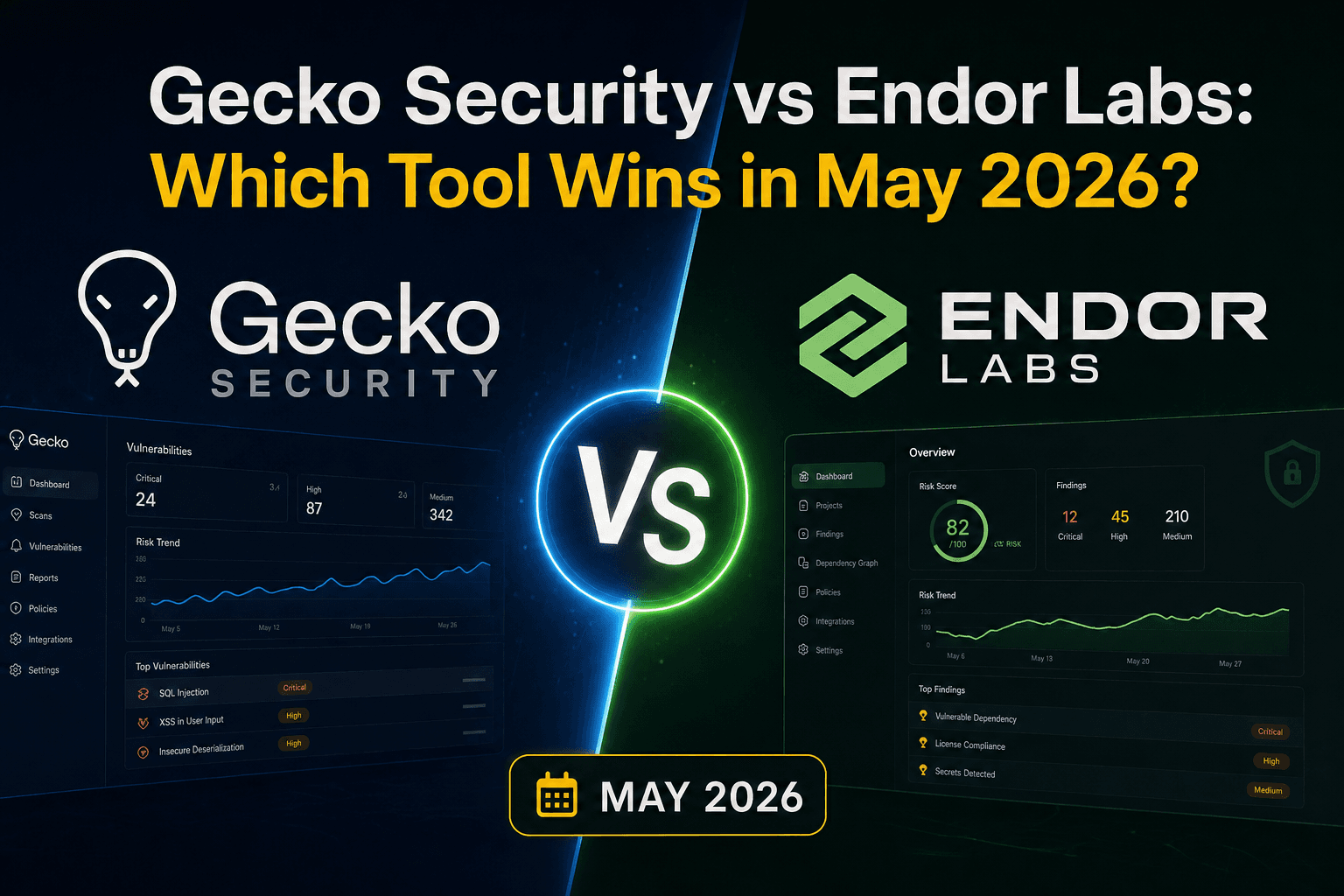
Gecko vs Endor Labs comes down to whether your open question is about dependencies or application code. Endor Labs is purpose-built for SCA: it maps reachability across your dependency graph so you know which vulnerable libraries your code actually calls, cutting the noise that makes traditional dependency scanners painful. Gecko Security is an AI-native AppSec tool that finds vulnerabilities in the code your engineers write — broken access control, privilege escalation, cross-service exploit chains — by reasoning over a semantic model that spans files, services, and trust boundaries. You can run both. You cannot substitute one for the other, because reachability analysis for third-party packages and semantic reasoning over first-party logic are structurally different problems.
TLDR:
Endor Labs is a reachability-based SCA tool built around a specific problem: most dependency scanners surface every CVE in your package tree, whether or not the vulnerable code path ever runs. Using function-level call graph analysis, it traces whether vulnerable functions in third-party packages are actually reachable from your application, filtering out findings that technically match but cannot be exploited in your specific context.
In late 2025, Endor Labs launched AI-native SAST capabilities using a multi-modal static analysis engine with specialized AI agents for first-party code scanning. That SAST layer is an expansion built on top of what remains a dependency security foundation.
Reachability analysis is a genuine improvement over naive SCA. Call graph pruning cuts the noise that makes traditional dependency scanners painful to work with, letting teams focus on CVEs where the execution path from their code into the vulnerable function is provable. For teams drowning in dependency alerts, that filtering matters.
The SAST expansion adds first-party code scanning to that foundation, giving Endor Labs a broader surface area than a pure SCA tool, though static analysis struggles with business logic vulnerabilities. The multi-modal approach combines multiple analysis signals instead of relying on a single detection method.
Gecko Security is an AI-native application security tool built to find vulnerabilities that traditional SAST tools miss. Where conventional scanners rely on pattern matching and single-file analysis, Gecko reasons over a compiler-accurate semantic graph that captures how code actually behaves across files, services, and trust boundaries.
The core difference is architectural. Gecko traces call chains inter-procedurally, follows tainted data across service boundaries, and incorporates context from outside the codebase itself, including infrastructure configuration and deployment context, to assess real exploitability. A finding that looks identical at the code level carries different risk depending on whether it sits behind an internal VPN or faces a public API. Gecko accounts for that.
Every finding comes with a working proof-of-concept exploit, so developers and security engineers spend time fixing confirmed vulnerabilities instead of triaging noise. Gecko has produced 30+ CVEs in 8 months through this approach, with confirmed findings in projects like Cal.com, ONYX, N8N, and Ollama.
The result is contextual AI SAST that reasons about what code was supposed to do, not just what it does.
Endor Labs and Gecko Security solve different problems, and understanding that split matters before comparing them.
Endor Labs focuses on software composition analysis (SCA): finding vulnerabilities in your third-party dependencies, understanding reachability so you know which vulnerable packages your code actually calls, and managing the software supply chain. If a CVE drops in a library you pull in, Endor Labs is built to catch that.
Gecko Security focuses on first-party code: the vulnerabilities your own engineers write. That covers business logic flaws, broken access control, authentication bypasses, and cross-service exploit chains that no dependency scanner will ever surface because they live in code you authored.
These two categories are complementary. SCA tools like Endor Labs and Snyk handle supply chain risk well, while business logic is AppSec's unsolved problem. What they cannot do is reason about whether your application logic is correct, or trace an exploit path across service boundaries in code your team wrote.
Most teams running SCA get good coverage on known CVEs in open-source packages. The vulnerabilities that keep appearing in post-mortems are the ones in first-party code: an authorization check that runs on every path except one, a trust boundary that breaks down when two services communicate, a logic flaw that no ruleset pattern will match because it requires understanding intent.
That gap is structural. A tool built to scan dependency trees cannot reason about application semantics.
Endor Labs centers its detection on reachability analysis: tracing whether a vulnerable dependency is actually called in your code before surfacing it as a finding. That's a meaningful filter over raw CVE counts, and it does reduce noise in the dependency layer. But reachability analysis is a scoped technique. It answers one question — does execution reach this function? — and stops there.
Gecko reasons over a compiler-accurate semantic graph that spans your entire codebase, tracing data flow, control flow, and trust boundaries across files, services, and call chains. Where Endor Labs asks whether code is reachable, Gecko asks whether a vulnerability is actually exploitable given how data moves through your application.
The gap shows up in practice: a dependency flagged as reachable by Endor Labs may still be unexploitable if an input validation layer upstream neutralizes the attack vector. Gecko's semantic model captures that context. Endor's reachability graph does not.
This also means Gecko operates across vulnerability classes that reachability analysis cannot reach at all — business logic flaws, broken access control, authentication bypasses — where the problem isn't a vulnerable library but incorrect behavior in first-party code.
Gecko and Endor Labs take fundamentally different approaches to finding vulnerabilities in application code, and those architectural differences determine what each tool can actually catch.
Endor Labs is built around software composition analysis (SCA). Its core strength is dependency graph analysis: it maps reachability across your dependency tree to separate vulnerabilities that can actually be reached from those that cannot, using static analysis techniques. That reachability filtering reduces noise meaningfully in large dependency graphs. What Endor Labs does not do is reason about your first-party code. It has no SAST engine analyzing how your application logic handles the dependencies it pulls in.
Gecko is an AI-native AppSec tool with a contextual SAST engine at its core. It builds a compiler-accurate semantic graph of your codebase, traces data flow inter-procedurally across files and services, and reasons about whether a vulnerability is exploitable given your specific deployment context. Every finding ships with a working proof-of-concept exploit.
| Capability | Gecko | Endor Labs |
|---|---|---|
| First-party SAST | Yes, AI-driven with semantic graph | No |
| SCA / dependency scanning | Yes | Yes, reachability-aware |
| Reachability analysis | Yes, across first-party call chains | Yes, dependency graph only |
| Business logic flaws | Yes | No |
| PoC exploit per finding | Yes | No |
| CI/CD integration | Yes | Yes |
| Auto-remediation PRs | Yes | No |
The gap is structural. Endor Labs cannot tell you whether your own code mishandles the libraries it calls, whether an authentication check is bypassable, or whether a privilege escalation exists inside your application logic. Those findings require reasoning over first-party code, which SCA tools are not built to do.
Gecko Security and Endor Labs take fundamentally different approaches to what they scan and how much context they bring to each finding.
Endor Labs focuses on software composition analysis (SCA), mapping open source dependencies, reachability, and license risk across a codebase. Its analysis stays at the dependency graph layer: which packages are present, which vulnerable functions are actually called, and whether a given CVE matters given how the code uses that library.
Gecko operates at the application layer. It reasons over a compiler-accurate semantic graph that spans files, services, and trust boundaries, ingesting context from outside the code itself, including infrastructure configuration and design intent, to separate findings that represent real attack paths from those that existing controls already neutralize.
The practical consequence: Endor Labs tells you whether a vulnerable dependency is reachable. Gecko tells you whether an attacker can actually exploit a path through your application, accounting for what your infrastructure does and does not protect.
These are different questions. For teams managing large open source footprints, both answers matter. The gap shows up when the threat is in the application logic itself, where dependency reachability data stops being useful.
Endor Labs fits well when your security program already has strong AppSec fundamentals and your primary concern is third-party dependency risk at scale. If your team manages large monorepos with hundreds of transitive dependencies, needs reachability analysis to cut through SCA noise, or operates under compliance frameworks that require software bill of materials (SBOM) generation, Endor Labs delivers genuine value in those areas.
Gecko fits when your concern is the code your team actually writes. If you're shipping AI-generated code at speed, running security reviews that need to go deeper than pattern matching, or trying to catch business logic flaws and authentication bypasses before they reach production, Gecko's semantic reasoning over a compiler-accurate code graph covers ground that reachability-focused SCA tools were never designed to cover.
The clearest signal for choosing between them: if your open question is "are our dependencies safe," Endor Labs answers it. If your open question is "is our application logic secure," that requires a different kind of analysis entirely.
Many teams will find the tools cover different layers of risk and are not substitutes for one another.
Gecko Security takes a fundamentally different approach to application security than Endor Labs. Where Endor Labs focuses on SCA, dependency graphs, and reachability analysis for open source risk, Gecko Security operates as an AI-native AppSec tool that reasons over a compiler-accurate semantic model of your codebase to find vulnerabilities traditional scanners miss entirely.
The core difference is what each tool can see. Endor Labs excels at tracking whether a vulnerable dependency is reachable in your call graph. Gecko Security goes further into the application layer itself, tracing inter-procedural data flows, reasoning about business logic correctness, and generating working proof-of-concept exploits for every finding it surfaces. No pattern matching. No rule libraries. Findings come with evidence.
Endor Labs is purpose-built for supply chain security. That scope is its strength and its ceiling. Gecko Security covers the vulnerabilities that live in your own code:
| Capability | Gecko Security | Endor Labs |
|---|---|---|
| SCA / dependency scanning | Via Snyk integration | Yes, core capability |
| Reachability analysis | Call-graph aware SAST | Dependency-level reachability |
| Business logic vulnerability detection | Yes | No |
| Cross-service taint tracking | Yes | No |
| Proof-of-concept exploit generation | Yes, every finding | No |
| AI-generated code scanning | Yes, PR-level | Limited |
| Auto-remediation with fix PRs | Yes | Partial |
| False positive rate | Low, context-aware | Moderate |
| Deployment | GitHub, GitLab, CI/CD | GitHub, GitLab, CI/CD |
If your primary concern is open source dependency risk, Endor Labs handles that well. If you need to find what lives in your application code, Gecko Security is the right tool. The two are not direct substitutes: Gecko integrates with Snyk for SCA coverage, so you do not have to choose between supply chain visibility and deep application security.
Endor Labs and Gecko solve different layers of risk, and understanding that split saves you from choosing the wrong tool for the problem you actually have. If your concern is third-party libraries, reachability analysis cuts the noise. If your concern is whether your own code does what it should, Gecko's semantic model traces the exploit paths that live in business logic and cross-service boundaries. You can see how Gecko works on your stack by booking time with us.
If your primary security gap is in third-party dependency risk and you need reachability filtering to cut SCA noise, Endor Labs handles that well. If your concern is the code your team writes—business logic flaws, broken access control, authentication bypasses—you need Gecko Security's semantic reasoning over first-party code. Many teams find these tools cover different layers of risk and are complementary.
Gecko Security is purpose-built for business logic vulnerabilities through semantic reasoning over a compiler-accurate code graph. Traditional SAST tools miss business logic flaws because they rely on pattern matching and cannot reason about whether code does what it should, only what it does. Gecko traces inter-procedural call chains and generates working proof-of-concept exploits for every finding.
No. Endor Labs is built for software composition analysis—mapping dependencies and filtering CVEs by reachability. It has no SAST engine analyzing your first-party application logic, so it cannot detect authorization bypasses, privilege escalation, or business logic flaws where the problem lives in code your team wrote.
Endor Labs uses reachability analysis to answer whether execution reaches a vulnerable function in a dependency. Gecko Security reasons over a compiler-accurate semantic graph to determine whether a vulnerability is exploitable given how data moves through your application and what your infrastructure protects. Reachability tells you if code can run; semantic reasoning tells you if an attacker can exploit it.
Gecko Security integrates with Snyk for dependency scanning, so you maintain supply chain visibility while gaining deep application security coverage. Gecko scans the code you write; SCA tools track the libraries you import. You fill the gap SCA was never designed to cover without losing dependency scanning.
Gecko Security
The latest news, technologies, and resources from our team.
How Cal.com consolidated noisy security tooling into one continuous, context-aware pull request security program with Gecko.
Gecko Security
See what actually changed in the OWASP Top 10 for 2026, from merged SSRF and XXE categories to new supply chain risks and scanner coverage gaps.

Jeevan Jutla
Gecko Security uncovered CVE-2026-21894 in August 2026, an n8n authorization bypass with CVSS 8.8. See why static tools missed it and how to remediate it.
Jeevan Jutla
Security misconfiguration is OWASP A05 for a reason. Learn how deployment context determines exploitability and how to fix gaps in August 2026.
Jeevan Jutla
How do modern AppSec vendors actually compare? This July 2026 capability map covers SAST, DAST, SCA, business logic flaws, and cross-service
Gecko Security
Break down your AppSec stack: what SAST, DAST, SCA, IAST, and pen testing each see — and what they miss. Updated July 2026 by Gecko Security.
Gecko Security
Occasional updates, new content, and insights. No spam; unsubscribe anytime.




