
Company
How Cal.com Rebuilt AppSec After Going Closed Source
How Cal.com consolidated noisy security tooling into one continuous, context-aware pull request security program with Gecko.
Gecko Security
 Gecko Security13 min read
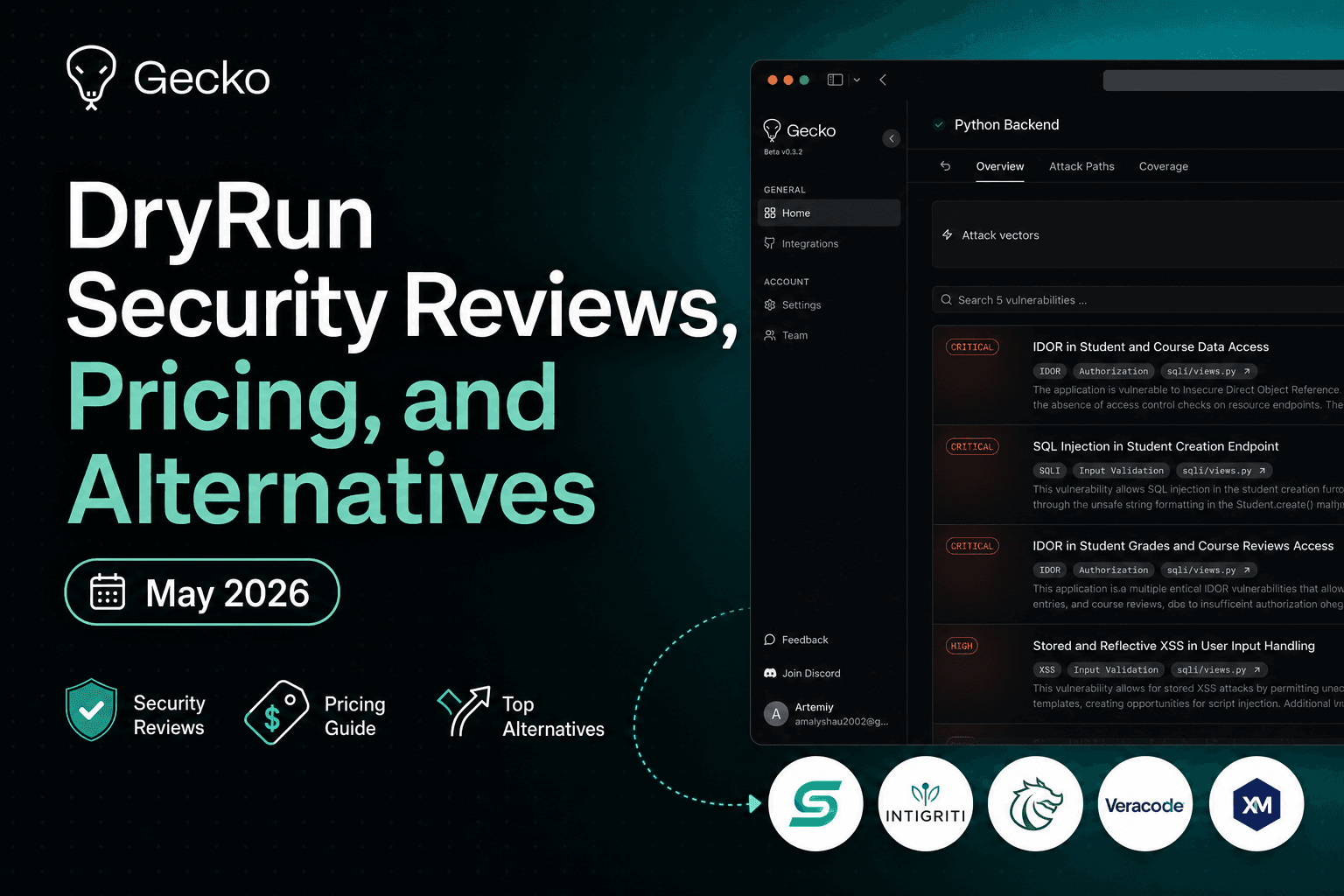
Most PR security tools work the same way: scan the code that changed, match it against a set of behavioral rules, and flag anything that looks risky. DryRun Security follows that model. It integrates with GitHub, runs analysis on every pull request, and surfaces findings as inline comments so security feedback lands where developers already work. If you're running dryrun security reviews and trying to decide whether to stick with the tool or compare dryrun pricing to other pr security tools, the question that matters most is whether the findings you're getting trace actual exploit paths or just highlight patterns that might be problems depending on how the rest of your system is configured. Tools that analyze diffs can't answer that question, because they don't see the full call chain or the infrastructure context that determines whether a vulnerability is reachable. That's not a tuning problem—it's an architectural one. The dryrun alternatives worth evaluating solve it by reasoning over semantic graphs instead of change-level patterns.
TLDR:
DryRun Security is a code security analysis tool built specifically for pull request (PR) workflows. Instead of running broad scans across an entire codebase, it focuses on the delta: the code that changed in a given PR. The idea is to catch security issues at the moment a developer submits code for review, before anything reaches production.
DryRun uses a combination of static analysis and AI-assisted review to evaluate code changes in context. When a PR is opened, it analyzes the diff, applies security-focused checks, and surfaces findings as inline comments or PR annotations.
Key aspects of how it operates:
This PR-scoped approach positions DryRun in a specific niche: shift-left security for development teams that want security feedback integrated into the code review process itself, without requiring a separate security scanning step.
DryRun Security does a specific job well: it analyzes pull requests for security issues before code merges. For teams that have felt the pain of catching vulnerabilities late in the release cycle, that focus has real appeal. But a narrow scope creates real tradeoffs, and those tradeoffs tend to surface quickly once teams move beyond basic use cases.
Several patterns push security teams to look elsewhere.
These are structural constraints, not configuration problems. The alternatives worth evaluating solve them at the architectural level.
DryRun Security occupies a narrow slice of the PR security review space, and that focus comes with real trade-offs. The alternatives below cover a range of architectures and use cases, so the right choice depends on what gaps you're trying to close.
Gecko Security is an AI-native application security tool built for PR-level code review. Where DryRun Security applies behavioral analysis to flag risky change patterns, Gecko reasons over a compiler-accurate semantic graph that spans files, services, and external context like threat intelligence and compliance requirements.
The practical difference shows up in finding quality. Every Gecko finding ships with a working proof-of-concept exploit and a verified fix, because the analysis traces actual call chains and trust boundaries rather than matching patterns against change diffs. That means fewer noise alerts routed to developers who have no way to act on them.
Gecko also connects to GitHub, GitLab, and Azure DevOps, running checks at the PR stage before code merges. Security teams get prioritized findings ranked by real exploitability. Developers get actionable remediation in the same review workflow they already use.
If your primary concern is the false positive rate and triage burden that comes with diff-level behavioral scanning, Gecko's semantic approach solves that at the root. You can try it free at app.gecko.security.
Semgrep is a widely used static analysis tool that lets security teams write custom rules in a pattern-matching syntax. It integrates into CI pipelines and supports a large library of community and proprietary rules across dozens of languages.
The structural limitation is that Semgrep operates at the file level. It cannot trace vulnerabilities across service boundaries or reason about whether a finding is exploitable given the actual deployment context. Rule maintenance is also an ongoing cost: as codebases evolve, rules require tuning to stay accurate.
Snyk focuses on dependency and supply-chain security, scanning open-source packages for known CVEs and license issues. It fits naturally alongside a PR security tool as a complementary layer covering third-party risk that code-focused scanners miss.
Snyk is not a direct substitute for behavioral or semantic PR analysis. It won't catch business logic flaws, broken access control, or vulnerabilities in first-party code. Teams running DryRun Security for change-level risk analysis would typically keep Snyk in place for the dependency layer rather than swap one for the other.
CodeRabbit is an AI code review assistant that provides automated PR feedback on code quality, bugs, and some security patterns. It uses LLM-based review to summarize changes and suggest improvements inline.
The gap is depth of security analysis. CodeRabbit is built around developer experience and review throughput, not security-first reasoning. It does not produce proof-of-concept exploits, does not trace inter-procedural call chains, and does not rank findings by exploitability. For teams that need security assurance at the PR stage rather than general code feedback, the coverage is limited.
DryRun Security is a PR-focused security tool built specifically for the code review stage. Instead of scanning repositories in bulk, it analyzes pull requests as they are opened, flagging security issues before code is merged. The tool integrates directly with GitHub, triggering automated security checks when a developer opens or updates a pull request. It applies a set of behavioral analysis rules—what DryRun calls "checklists"—to detect vulnerability patterns like secrets exposure, injection risks, and authentication changes within the diff. Findings surface as inline comments on the pull request itself, keeping security feedback inside the workflow developers already use. The analysis scope is intentionally limited to what changed in the PR, which reduces noise but also means vulnerabilities that span multiple files or require cross-service context fall outside what the tool can detect.
Here is what the tool covers:
The core idea is shift-left: catch issues at the PR stage before they reach production. For small teams without dedicated AppSec staff, that workflow integration is the main draw.
DryRun Security analyzes pull requests at the point of contribution, flagging security issues before code reaches the merge stage. The tool hooks into GitHub workflows and runs behavioral checks against the diff—the specific lines that changed—rather than scanning the entire repository. It surfaces findings as inline comments on the pull request itself, keeping security feedback inside the developer's existing review workflow. Detection covers common vulnerability classes like secrets exposure, injection risks, and insecure dependencies, using a set of predefined analyzers DryRun calls "checklists" that teams can enable or disable per repository. The scope is intentionally limited to what changed in the PR, which reduces noise but also means vulnerabilities that span multiple files or exist outside the diff fall outside what the tool can detect.
DryRun Security focuses on PR-level code review, scanning pull requests as they are opened to flag security issues before code merges. The product integrates with GitHub and uses a set of behavioral analyzers it calls "checklists" to categorize findings by vulnerability type. Each checklist targets a specific vulnerability class—secrets exposure, injection risks, authentication changes, insecure dependencies—giving teams granular control over which checks run on a given repository. Findings surface as inline comments directly on the diff, keeping security feedback inside the pull request interface where developers already work. The analysis scope is intentionally limited to what changed in the PR, which reduces noise from pre-existing issues but also means vulnerabilities that span multiple files or require cross-service context fall outside what the tool can detect. DryRun positions this narrow scope as a feature for teams that want shift-left feedback without routing work through a dedicated security review queue.
Here is what the product covers:
The tool is built for teams that want security feedback earlier in the development cycle without routing work through a dedicated security team. Coverage is intentionally scoped to what is visible inside a single pull request, which keeps noise low but also means cross-file and cross-service vulnerability patterns fall outside what the analyzer can reach.
DryRun Security scans pull requests at the point of contribution, analyzing the diff to flag security issues before code merges into the main branch. The tool integrates with GitHub workflows and runs automated checks against what changed in each PR, surfacing findings as inline comments directly on the code review interface. Detection covers common vulnerability classes—secrets exposure, injection risks, insecure dependencies, and authentication changes—using a set of behavioral analyzers DryRun calls "checklists" that teams can enable or disable per repository. The analysis scope is limited to what appears in the pull request diff, which keeps noise low by filtering out pre-existing issues but also means vulnerabilities that span multiple files or require cross-service context fall outside what the tool can detect. For teams that want shift-left feedback without routing work through a dedicated security review queue, that narrow scope is the main value proposition: security checks run automatically on every PR, developers see findings without leaving GitHub, and the review cycle stays inside the workflow engineers already use.
The table below maps key capabilities across DryRun Security and its main alternatives, covering scanning scope, detection depth, and pricing structure.
| Feature | DryRun Security | Gecko Security | Snyk | Semgrep | Nullify.ai |
|---|---|---|---|---|---|
| Primary focus | PR-level code change analysis | AI-native contextual AppSec | Dependency & SAST scanning | SAST & custom rules | AI-assisted SAST |
| Detection approach | Rule-based PR diff scanning | Compiler-accurate semantic graph | Pattern matching + SCA | Pattern matching + AST | Pattern matching + AI triage |
| Cross-file / inter-procedural analysis | Limited | Yes | Partial | Limited | Partial |
| Business logic vulnerability detection | No | Yes | No | No | No |
| AI-generated fix suggestions | No | Yes, with PoC exploit | No | No | Yes |
| CI/CD integration | Yes | Yes | Yes | Yes | Yes |
| PR blocking / merge gating | Yes | Yes | Yes | Yes | Yes |
| Context outside the codebase (infra, design docs) | No | Yes | No | No | No |
| False positive reduction mechanism | Rule tuning | Semantic reasoning over full call graph | Severity filters | Rule suppression | AI triage layer |
| Pricing model | Per-seat / contact | Contact for pricing | Freemium + paid tiers | Free + Team/Enterprise | Contact for pricing |
The gap that stands out most in this table is business logic detection. DryRun Security, Snyk, Semgrep, and Nullify all operate on pattern matching against code structure. None of them reason about whether code does what it was supposed to do, only whether known-bad patterns appear.
Gecko Security approaches this differently. Instead of matching patterns against a diff or a file, it reasons over a compiler-accurate semantic graph that preserves call chains, trust boundaries, and type relationships across the full codebase. Every finding includes a working proof-of-concept exploit—a flag with verified reachability—because the analysis has enough context to trace the actual exploit path instead of inferring it from surface patterns.
Gecko Security takes a fundamentally different approach to PR security than DryRun. Where DryRun focuses on behavior-based analysis of code changes, Gecko reasons over a compiler-accurate semantic graph that spans files, services, and external context — catching vulnerabilities that exist only across trust boundaries or in the interaction between components.
Most PR security tools read code the way a linter does: file by file, change by change. Gecko builds a full semantic model of your codebase and reasons over call chains, data flows, and authorization logic the way a security researcher would.
| Capability | DryRun Security | Gecko Security |
|---|---|---|
| Analysis scope | Change-level behavior analysis | Full semantic graph across files and services |
| Proof-of-concept exploits | No | Yes, per finding |
| Cross-service vulnerability detection | Limited | Yes, inter-procedural by design |
| AI-generated fixes | Limited | Yes, context-aware and complete |
| Business logic vulnerability detection | Partial | Yes, via semantic reasoning |
| PR workflow integration | Yes | Yes, with merge-blocking and auto-remediation |
| False positive approach | Rule-based filtering | Exploit-verified findings |
Security teams that have outgrown pattern-matching tools and need evidence-backed findings with full codebase context will find Gecko's approach materially different from what DryRun offers.
DryRun Security works well if your primary goal is catching surface-level security issues at the PR stage without additional triage burden. The limitation is structural: diff-scoped tools cannot reason about vulnerabilities that exist across trust boundaries or require understanding what code was supposed to do. If your threat model includes business logic flaws, broken access control, or IDOR, you need a tool that traces call chains and produces working exploits, not just flags. Book time with us to see how Gecko's semantic approach compares in practice.
DryRun Security analyzes only pull request diffs, which means it cannot detect vulnerabilities that span multiple files, services, or commits. If your codebase has already shipped broken access control or authorization bypasses into production, a PR-scoped tool will never surface them because it only looks at what changed, not what exists.
If you're discovering business logic vulnerabilities in production that your PR checks missed, or if developers are dismissing security alerts because findings lack exploitability proof, you've hit the structural limit of change-level analysis. Tools that reason over the full codebase and verify findings with working exploits solve both problems at the architectural level.
Look for cross-file and cross-service analysis that can trace authorization logic across trust boundaries, automatic proof-of-concept generation so developers see exactly how a vulnerability is reachable, and context integration beyond code (infrastructure topology, API contracts, design documents) to rank findings by real business risk rather than pattern-match severity.
Gecko Security
The latest news, technologies, and resources from our team.
How Cal.com consolidated noisy security tooling into one continuous, context-aware pull request security program with Gecko.
Gecko Security
See what actually changed in the OWASP Top 10 for 2026, from merged SSRF and XXE categories to new supply chain risks and scanner coverage gaps.

Jeevan Jutla
Gecko Security uncovered CVE-2026-21894 in August 2026, an n8n authorization bypass with CVSS 8.8. See why static tools missed it and how to remediate it.
Jeevan Jutla
Security misconfiguration is OWASP A05 for a reason. Learn how deployment context determines exploitability and how to fix gaps in August 2026.
Jeevan Jutla
How do modern AppSec vendors actually compare? This July 2026 capability map covers SAST, DAST, SCA, business logic flaws, and cross-service
Gecko Security
Break down your AppSec stack: what SAST, DAST, SCA, IAST, and pen testing each see — and what they miss. Updated July 2026 by Gecko Security.
Gecko Security
Occasional updates, new content, and insights. No spam; unsubscribe anytime.




