
Company
How Cal.com Rebuilt AppSec After Going Closed Source
How Cal.com consolidated noisy security tooling into one continuous, context-aware pull request security program with Gecko.
Gecko Security
 Gecko Security7 min read
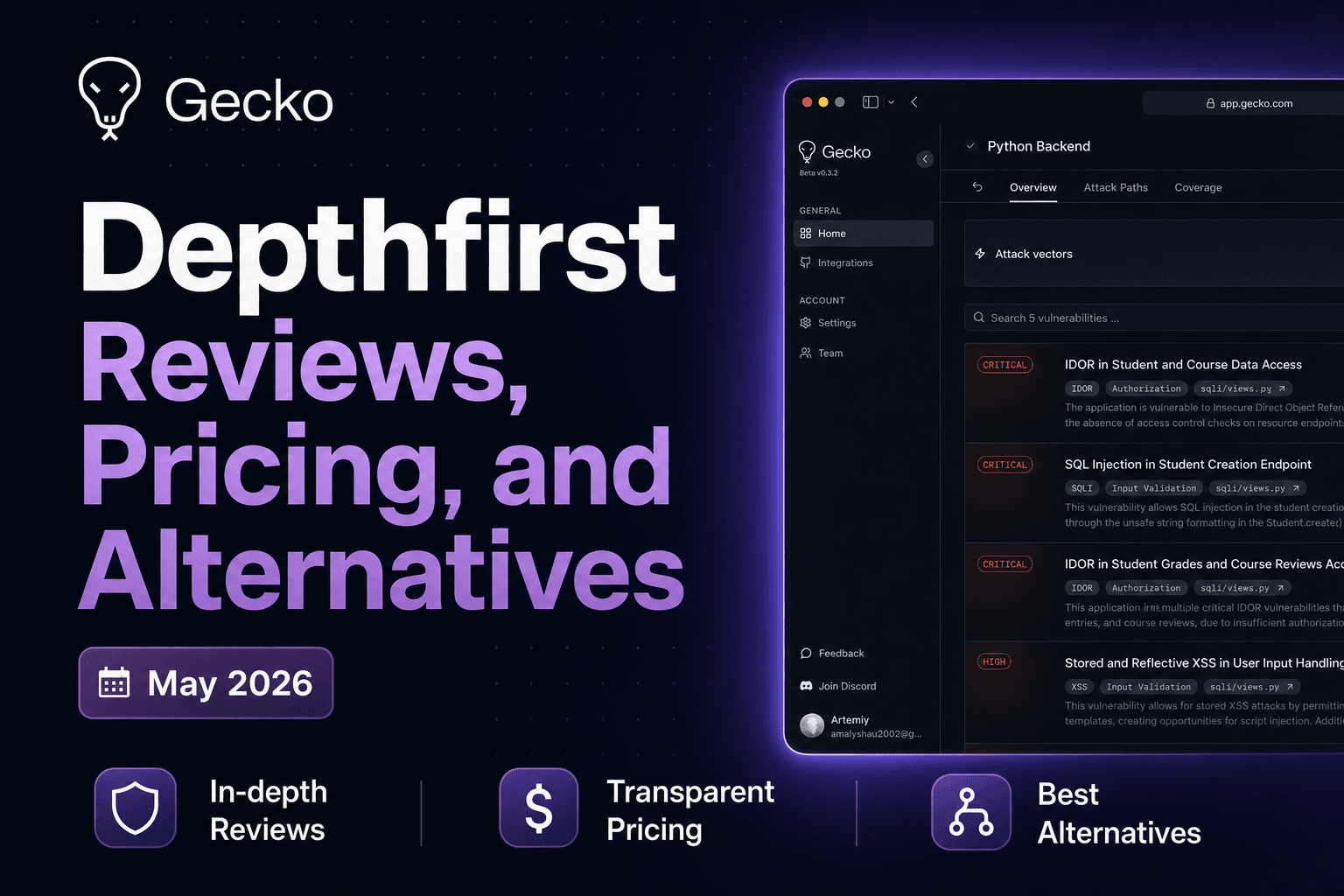
If you've been reading Depthfirst reviews trying to figure out whether it's the right fit, you're probably stuck on one of two things: either the feature set looks good but the pricing doesn't work for your team size, or you need deeper code analysis than what AI-assisted scanning provides. Depthfirst excels at triage and remediation across codebases, but specialized detection of authorization flaws, business logic bugs, and exploitability proofs requires different tooling. This comparison walks through where Depthfirst works, where it doesn't, and which alternatives cover the gaps depending on whether you care more about depth of analysis or breadth of coverage.
TLDR:
Depthfirst is an AI-native security company founded in 2024, positioning itself as an applied AI lab built for the AI era. Its core product, General Security Intelligence, detects, triages, and remediates vulnerabilities across every layer of software and infrastructure using custom AI agents that run continuously in the background. Like other modern AI-powered SAST platforms, it aims to reduce manual triage overhead.
Depthfirst aims to fully understand a customer's code, context, and threat model. Those agents analyze codebases, infrastructure, and workflows to catch complex threats like backdoors, malware, and code defects. Depthfirst claims they uncover 8x more true-positive vulnerabilities than traditional static analysis tools while cutting false positives by 85%.
Depthfirst works well for teams needing broad AI-driven threat detection across code and infrastructure. Its strength is in triage and remediation workflows. But that focus also creates gaps.
Teams dealing with broken access control, IDOR, or authorization bypass patterns across microservices often need more specialized tooling. Deep semantic code analysis with compiler-accurate indexing isn't what Depthfirst was built for. Neither is automated proof-of-concept exploit generation, which confirms whether a vulnerability is actually exploitable before anyone invests time remediating it.
Other common reasons teams look elsewhere:
The right fit depends entirely on what you're trying to solve.
If you're weighing options beyond Depthfirst, the market has a few tools worth considering depending on your team's priorities around depth of analysis, language support, and how much manual triage you want to handle.
Gecko Security takes an AI-driven approach to code security, running autonomous security agents that think through vulnerabilities the way a skilled human researcher would. It traces attack paths across files, functions, and services to surface the kinds of bugs that matter in production.
It covers SAST, secrets detection, and dependency scanning in a single workflow, with results that go well beyond a list of line numbers.
Semgrep is a well-known static analysis tool built around customizable rules. It's fast and developer-friendly, but rule quality determines result quality, which puts the burden back on your team.
Snyk focuses heavily on dependency and container security. It integrates cleanly into CI/CD pipelines but offers shallower code analysis compared to tools targeting inter-procedural vulnerabilities.
Built directly into GitHub, this option works well for teams already deep in that ecosystem. It covers secret scanning and CodeQL-based analysis, though complex cross-file logic flaws can still slip through.
Depthfirst integrates directly into CI/CD pipelines and source control workflows, scanning pull requests and existing repositories to surface findings before they reach production. The tool claims to reduce false positives by 85% compared to traditional SAST tools while uncovering 8x more true-positive vulnerabilities, which translates to fewer hours spent triaging noise and more time fixing issues that actually matter. Findings come with developer-facing reports that explain vulnerabilities in plain language and include ready-to-merge remediation suggestions, making results accessible to engineers who may not have deep security backgrounds.
Pricing details for Depthfirst aren't publicly listed, which is common for enterprise security tools that scale based on repository count, team size, and scan frequency. Early-stage companies and smaller security teams report that Depthfirst's pricing model can be prohibitive compared to alternatives with transparent tier structures, particularly if you're protecting fewer than ten repositories or operating with a lean security headcount. The lack of publicly available pricing means you'll need to go through a sales conversation to understand whether the tool fits your budget, which adds friction if you're comparing multiple tools simultaneously.
When comparing Depthfirst against alternatives, the decision hinges on whether you need broad AI-driven coverage across infrastructure layers or deep semantic analysis for specific vulnerability classes. Teams dealing with broken access control across microservices, privilege escalation patterns, or IDOR vulnerabilities often need tooling that goes beyond triage automation to provide compiler-accurate indexing and proof-of-concept exploit generation. The gap isn't in what Depthfirst does well (autonomous background scanning and remediation workflow) but in the specialized detection capabilities required for business logic flaws that arise from how services interact versus how individual functions handle data.
The table below puts the key capabilities side by side across Depthfirst and its top alternatives. A few cells worth calling out: Gecko Security is the only tool in this group that generates automatic proof-of-concept exploits alongside findings, which matters when you need to communicate risk to engineering teams quickly. Cross-microservice analysis is rare, with only Depthfirst and Gecko covering it. Business logic vulnerability detection is where most tools fall short entirely, and that gap has real consequences for teams shipping complex, interconnected services.
| Capability | Depthfirst | Gecko Security | Semgrep | Snyk | GitHub Advanced Security |
|---|---|---|---|---|---|
| Business Logic Vulnerability Detection | Limited | Yes | No | No | No |
| Cross-Microservice Analysis | Yes | Yes | No | No | No |
| Automatic PoC Generation | No | Yes | No | No | No |
| Semantic Code Understanding | Yes | Yes (Code Property Graph) | Limited (Pattern-based) | Limited (DeepCode AI) | Yes (CodeQL) |
| PR-Level Scanning | Yes | Yes | Yes | Yes | Yes |
| Automated Remediation | Yes | Yes | Limited | Yes (DeepCode AI) | Limited |
| SCA / Dependency Scanning | Yes | No | Limited | Yes | Yes (Dependabot) |
| False Positive Reduction | 85% reduction claimed | Significantly lower | Standard | Standard | Standard |
| Container Security | Yes | No | No | Yes | Yes |
Gecko Security takes a fundamentally different approach to code security than Depthfirst. Where Depthfirst focuses on AI-assisted code review within a defined workflow, Gecko is built around autonomous AI agents that conduct full security audits across your entire codebase without requiring human orchestration at each step.
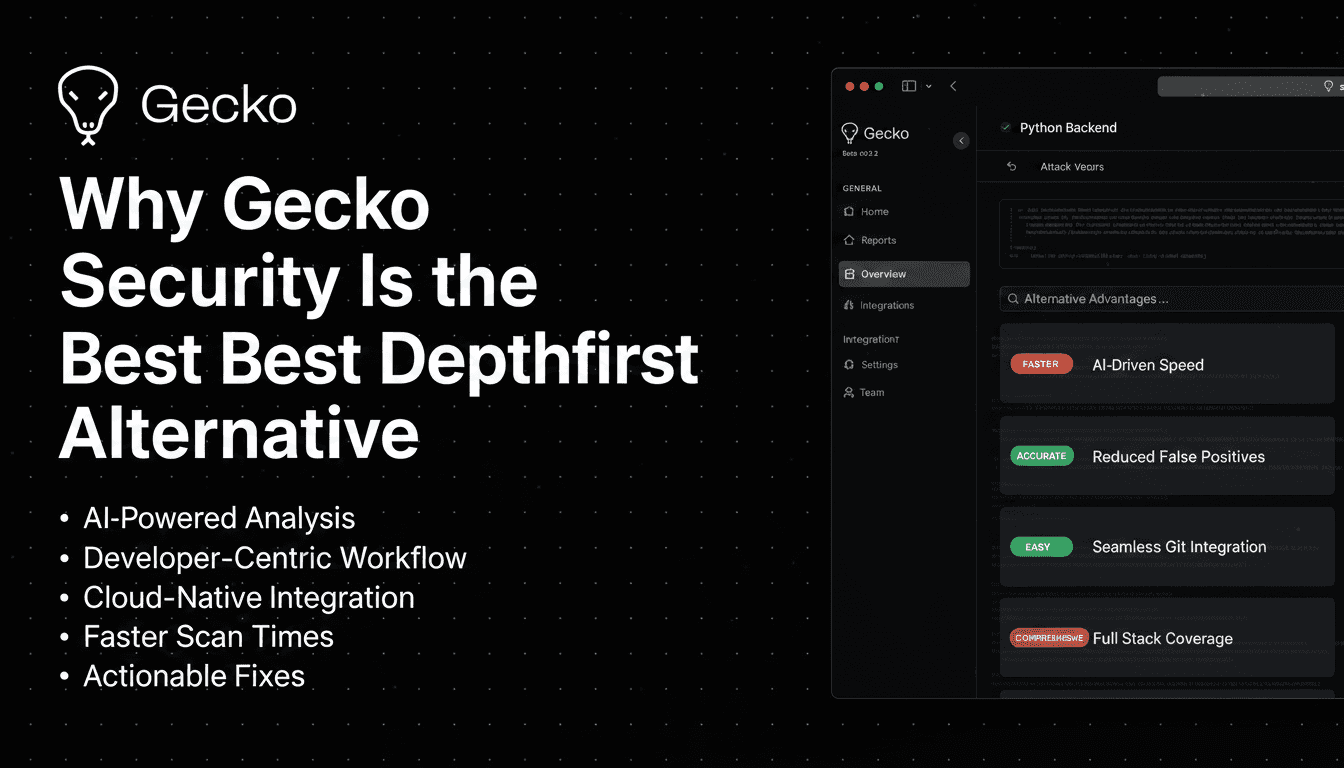
The core difference is depth of analysis. Gecko's agents trace vulnerabilities across file boundaries, follow call chains through multiple abstraction layers, and reason about business logic flaws that pattern-based scanners miss entirely. This is the kind of inter-procedural analysis that catches real-world vulnerabilities before attackers do.
For teams that need thorough, credible security analysis without dedicating weeks of engineering time, Gecko closes the gap that lighter review tools leave open.
Choosing between Depthfirst and its alternatives comes down to how deep you need your analysis to go. Tools that specialize in code security at the semantic level, like Gecko Security, catch business logic flaws and cross-service vulnerabilities that pattern matchers miss entirely. You're deciding which classes of vulnerabilities you can actually defend against. If you want to talk through what coverage makes sense for your team, grab time here. The right tooling depends on the threats you're actually facing, not what sounds good in a feature comparison.
Look elsewhere if you need specialized tooling for business logic vulnerabilities like IDOR or authorization bypass across microservices, automated proof-of-concept generation to confirm exploitability, or compiler-accurate semantic analysis that traces attack chains through complex polyglot architectures. Depthfirst's strength is broad AI-driven triage, not deep inter-procedural code understanding.
Focus on cross-repository analysis for microservice architectures, automatic PoC generation that proves vulnerabilities are actually exploitable, semantic code understanding beyond pattern matching (like Code Property Graphs versus AST parsing), and false positive rates with concrete reduction percentages. These capabilities separate surface-level scanners from tools that catch real production vulnerabilities.
Gecko runs autonomous security agents that conduct full audits without manual orchestration, using compiler-accurate indexing to trace vulnerabilities across file boundaries and reason about business logic flaws that pattern-based tools miss entirely, while Depthfirst focuses on AI-assisted code review within defined workflows with broader coverage across infrastructure layers.
Broken access control, missing authorization checks, privilege escalation, and multi-step vulnerability chains require understanding how code should behave and whether security intent is actually enforced. Pattern matching catches syntactic issues like injection attacks, but semantic vulnerabilities arise from interactions across systems that no single rule can capture.
Gecko Security
The latest news, technologies, and resources from our team.
How Cal.com consolidated noisy security tooling into one continuous, context-aware pull request security program with Gecko.
Gecko Security
See what actually changed in the OWASP Top 10 for 2026, from merged SSRF and XXE categories to new supply chain risks and scanner coverage gaps.

Jeevan Jutla
Gecko Security uncovered CVE-2026-21894 in August 2026, an n8n authorization bypass with CVSS 8.8. See why static tools missed it and how to remediate it.
Jeevan Jutla
Security misconfiguration is OWASP A05 for a reason. Learn how deployment context determines exploitability and how to fix gaps in August 2026.
Jeevan Jutla
How do modern AppSec vendors actually compare? This July 2026 capability map covers SAST, DAST, SCA, business logic flaws, and cross-service
Gecko Security
Break down your AppSec stack: what SAST, DAST, SCA, IAST, and pen testing each see — and what they miss. Updated July 2026 by Gecko Security.
Gecko Security
Occasional updates, new content, and insights. No spam; unsubscribe anytime.




