
Company
How Cal.com Rebuilt AppSec After Going Closed Source
How Cal.com consolidated noisy security tooling into one continuous, context-aware pull request security program with Gecko.
Gecko Security
 Gecko Security8 min read
The adoption pattern is telling. Developers route their hardest review work to Claude and leave simpler autocomplete tasks to whatever's already integrated in the IDE. That split reveals something about Claude AI code quality that raw benchmark numbers don't capture. When you need cross-file reasoning, business logic validation, or vulnerability detection that goes beyond pattern matching, you reach for the tool that reads code the way a senior engineer does. The regression in March made that gap visible. The recovery in May made it quantifiable.
TLDR:
Software development has grown substantially more complex over the past few years. Codebases are larger, teams are more distributed, and the cost of shipping broken or insecure code has never been higher. A single vulnerability in production can expose user data, break integrations, or trigger compliance failures that take months to remediate.
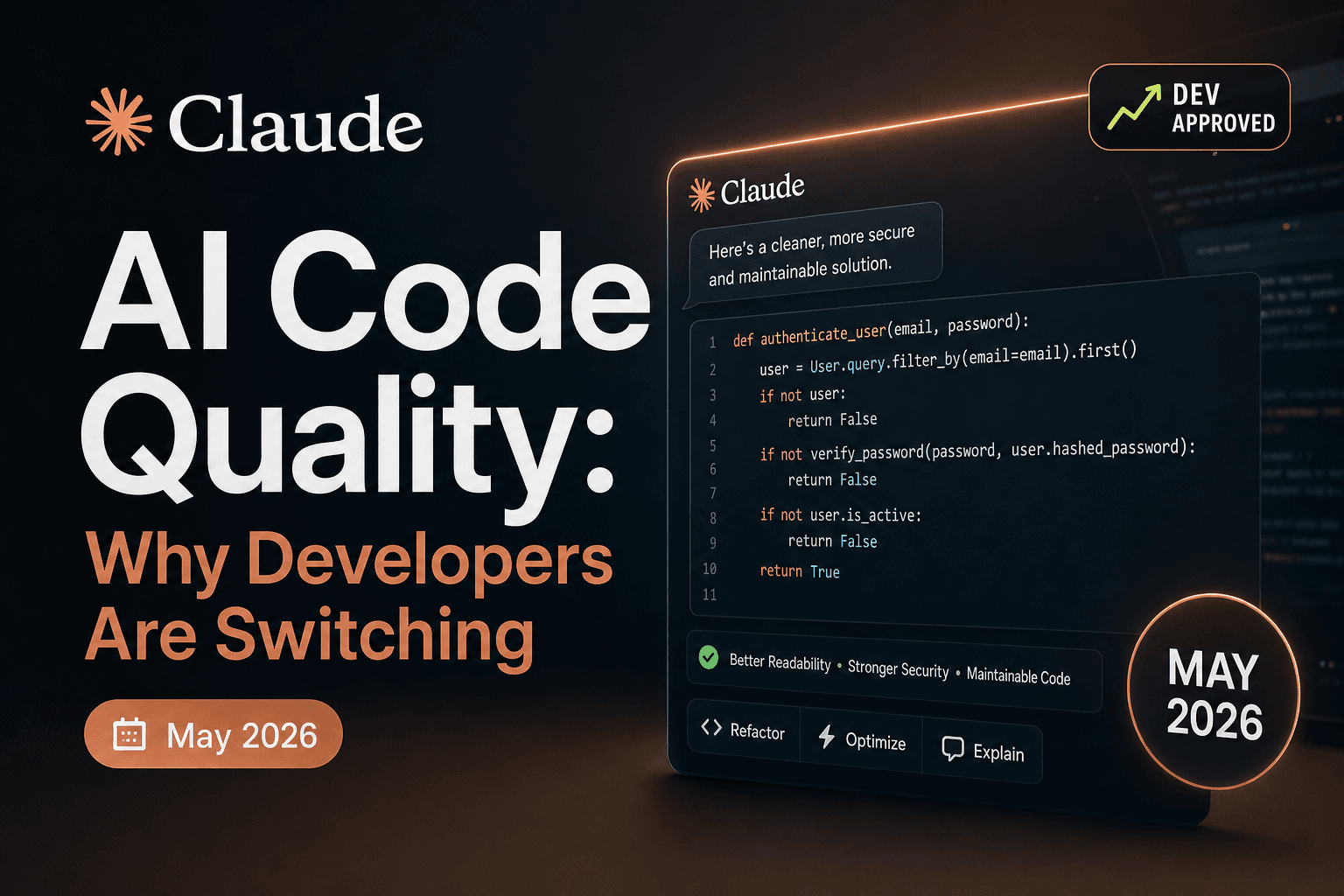
Claude AI code quality has become a genuine topic of discussion among engineering teams because the bar for what "good enough" looks like has risen sharply. Developers need AI assistance that goes beyond autocomplete. They need a tool that understands context across files, reasons about edge cases, and flags potential issues before they reach review.
There are a few specific pressures driving this in 2026:
Teams assessing AI coding assistants are asking harder questions now. Beyond "can it write code?" they want to know "can it write code I can trust?"
Between March and April 2026, Claude Code went through six rough weeks that had developers questioning whether the tool had fundamentally changed. Three separate product-layer modifications stacked on top of each other, and the cumulative effect was hard to miss.
The first hit March 4: Anthropic downgraded internal reasoning effort from high to medium, reducing thinking depth on complex tasks. On March 26, a caching bug began erasing stored reasoning context entirely, meaning Claude started from scratch on tasks where prior chain-of-thought should have carried forward. Then on April 16, a verbosity cap cut output quality by another 3%. Each change alone might have been tolerable. Together, they compounded.
Dave Kennedy, CEO of cybersecurity firm TrustedSec, quantified what developers were noticing: a 47% drop in Claude's code quality during this period, tracking defects, security issues, and task completion rates across real workloads.
Anthropic identified and resolved all three issues. As of April 20, version 2.1.116 restored Claude Code CLI, Claude Agent SDK, and Claude Cowork to previous behavior. For teams that stepped back during that window, the regression was real but it's over.
The benchmarks for Claude Opus 4.7 are the clearest signal that Anthropic treated the spring regression as a forcing function rather than just a bug to patch. On Rakuten-SWE-Bench, Opus 4.7 resolves 3x more production tasks than Opus 4.6, with double-digit gains in both Code Quality and Test Quality scores. Rakuten-SWE-Bench tests against real repository tasks pulled from production codebases, so those gains reflect actual engineering workloads.
Code review workloads tell a complementary story: recall improved by over 10% while precision stayed stable. That combination matters because higher recall alone means more noise. Holding precision steady while raising recall means genuinely better coverage.
| Metric | Claude Opus 4.6 | Claude Opus 4.7 |
|---|---|---|
| Production task resolution (Rakuten-SWE-Bench) | Baseline | 3x improvement |
| Code Quality score | Baseline | Double-digit gain |
| Test Quality score | Baseline | Double-digit gain |
| Code review recall | Baseline | +10% |
| Code review precision | Baseline | Stable |
For developers evaluating AI coding assistants right now, the recall-precision balance is the metric worth anchoring to. Raw completion speed is easy to game on benchmarks. Catching what matters without generating noise is harder, and Opus 4.7's numbers suggest it's moving in the right direction.
Claude's handling of business logic vulnerabilities is where its code quality advantages become most apparent. Most static analysis tools scan for known patterns: SQL injection, buffer overflows, hardcoded secrets. Business logic flaws are harder because they require understanding what the code is supposed to do, beyond just what it does.
Consider an authentication bypass where a user can escalate privileges by manipulating request ordering across three separate service calls. No individual file contains the vulnerability. A traditional SAST tool sees clean code. Claude sees the sequence and flags the race condition in the authorization check.
This is why developers working on security-sensitive features increasingly reach for Claude during review. It reasons across call chains, tracks how data mutates through layers, and asks whether the logic itself is correct.
These are the bugs that slip past automated tooling and junior reviewers alike. Claude catches them because it reads code the way a senior engineer does: with intent in mind.
The adoption story inside Microsoft is telling. Over six months, employees gravitated toward Claude Code over GitHub Copilot, specifically because of the feature gap between the two products. Microsoft eventually transitioned staff to Copilot CLI, but the preference itself is a clear signal: when given a choice, developers picked the tool that performed better.
Enterprise teams have followed a similar path, routing security-sensitive review work to Claude while keeping simpler tasks in existing tools. The pattern is consistent across organizations.
This is worth grounding in something concrete. Teams aren't doing full migrations overnight. The more common pattern looks like this:
The result is a two-tier setup that many engineering teams have settled into by mid-2026: one tool for speed, one tool for depth. Claude has claimed the depth slot reliably enough that this split has become something of a default arrangement for teams that care about code quality at the review stage.
Gecko Security builds on Claude's code reasoning to power an automated vulnerability detection engine that goes beyond surface-level pattern matching. Where traditional static analysis tools flag known signatures, Gecko's approach traces execution paths across entire codebases, following data from entry points through function calls, third-party libraries, and authentication boundaries.
The process starts with ingesting a repository at scale. Claude reads across files simultaneously, building a semantic picture of how components interact rather than scanning each file in isolation. This matters because real vulnerabilities rarely live in one place.
From there, Gecko's engine identifies suspicious flows: untrusted input reaching a sink without proper sanitization, privilege checks that appear enforced on one path but bypassed on another, or business logic that looks correct locally but breaks down across service boundaries.
The output goes beyond a line number and a CVE reference. Each finding includes:
This is why the combination of Claude's reasoning depth and Gecko's vulnerability-focused tooling produces results that pure LLM prompting or legacy SAST tools cannot replicate on their own.
The conversation around Claude AI code quality has moved past benchmarks and into real security workflows because teams need tools that reason about correctness, not just syntax. You're shipping code faster than human reviewers can catch every edge case, which means your AI assistance needs to think through call chains and business logic the way a senior engineer would. Vulnerabilities hiding in multi-step authentication flows or authorization checks won't show up in static pattern matching, but they will surface in production if your tooling can't trace execution paths across files. Set up a call to walk through how Gecko pairs Claude's reasoning with security-focused detection for your codebase.
Claude performs better on security-sensitive code review tasks because it reasons across call chains and tracks intent, while GitHub Copilot focuses on autocomplete and local context. This is why Microsoft employees initially preferred Claude Code for complex review work before the internal Copilot CLI transition.
Yes. Claude identifies business logic flaws by understanding what code is supposed to do, catching issues like authentication bypasses across multi-step service calls or privilege escalation through race conditions that don't appear in any single file. Traditional SAST tools only pattern-match known vulnerability signatures and miss these intent-based flaws.
Three product changes stacked between March and April 2026: internal reasoning effort downgraded from high to medium on March 4, a caching bug erased stored context on March 26, and a verbosity cap reduced output quality by 3% on April 16. Anthropic resolved all three issues by April 20 in version 2.1.116.
Gecko uses Claude to read across entire codebases simultaneously, building a semantic picture of component interactions rather than scanning files in isolation. The engine traces execution paths from entry points through function calls and authentication boundaries, then generates findings with plain-language explanations, full call chains, and context-grounded remediation rather than generic line-number references.
Use Claude Code for reviews involving cross-file logic, security edge cases, or complex reasoning where missed connections have real consequences. Teams commonly keep simpler autocomplete tasks in existing IDE-integrated tools while routing depth-requiring work to Claude—creating a two-tier setup that prioritizes speed for boilerplate and reasoning quality for critical paths.
Gecko Security
The latest news, technologies, and resources from our team.
How Cal.com consolidated noisy security tooling into one continuous, context-aware pull request security program with Gecko.
Gecko Security
See what actually changed in the OWASP Top 10 for 2026, from merged SSRF and XXE categories to new supply chain risks and scanner coverage gaps.

Jeevan Jutla
Gecko Security uncovered CVE-2026-21894 in August 2026, an n8n authorization bypass with CVSS 8.8. See why static tools missed it and how to remediate it.
Jeevan Jutla
Security misconfiguration is OWASP A05 for a reason. Learn how deployment context determines exploitability and how to fix gaps in August 2026.
Jeevan Jutla
How do modern AppSec vendors actually compare? This July 2026 capability map covers SAST, DAST, SCA, business logic flaws, and cross-service
Gecko Security
Break down your AppSec stack: what SAST, DAST, SCA, IAST, and pen testing each see — and what they miss. Updated July 2026 by Gecko Security.
Gecko Security
Occasional updates, new content, and insights. No spam; unsubscribe anytime.




