
Company
How Cal.com Rebuilt AppSec After Going Closed Source
How Cal.com consolidated noisy security tooling into one continuous, context-aware pull request security program with Gecko.
Gecko Security
 Gecko Security8 min read
Everyone's solving SQL injection. Nobody's solving the three-service authorization gap that lets attackers bypass your gateway checks entirely. Your traditional SAST stops at the file level, maybe the repository level if you're lucky. But contextual security scanning across microservices requires following data through API contracts, message brokers, and trust boundaries that most tools never even see. Here's what actually works when your architecture spans dozens of services.
TLDR:
Data flow analysis traces how data moves through an application, from where it enters (sources) to where it gets processed or stored (sinks). The goal is straightforward: find paths where untrusted input reaches sensitive operations without proper validation along the way.
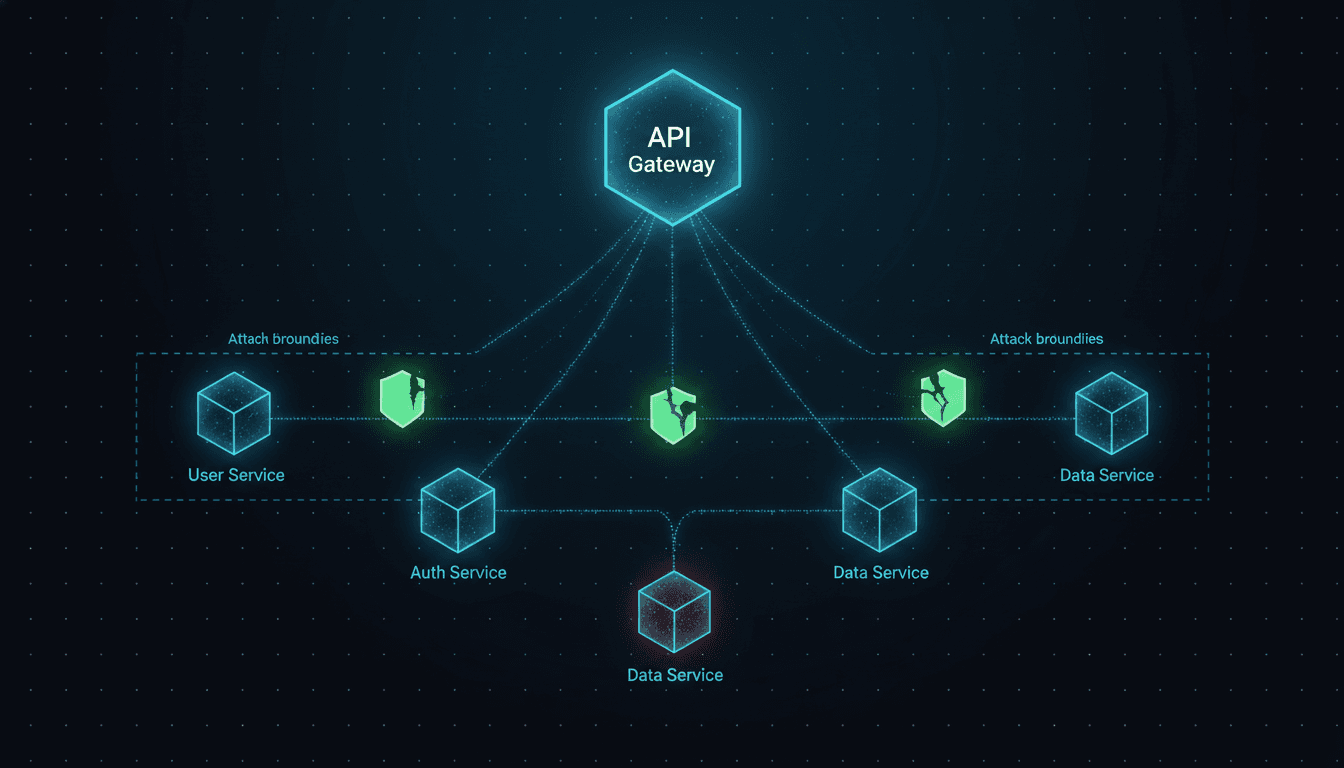
In practice, this catches injection flaws, broken access control, and insecure data handling. Where it gets interesting is in distributed architectures, where data crosses service boundaries, message queues, and API layers before reaching its destination. A single trust boundary violation buried in a microservice call chain can expose the entire system.
Knowing where data goes is only half the picture. The harder question is whether the right checks exist at every point along the way, across every layer of the stack.
Comparing security testing tools fairly requires clear criteria. Here's what we looked at for each tool in this list, based on publicly available documentation, vendor claims, and verified research.
The core evaluation criteria:
A few caveats worth being upfront about. We did not run identical test suites across every tool. Where we had direct experience, we used it. For the rest, we relied on published documentation, research disclosures, and what vendors publicly claim their tools can do. We've flagged where claims are harder to independently verify.
The bar we set is intentional. Finding SQL injection is a solved problem. The tools worth your attention in 2026 are the ones that can reason about whether authorization logic is actually correct across a distributed call chain, beyond simply checking whether a payload escapes sanitization.
Gecko Security builds a semantic model of your entire application by tracing data flows and trust boundaries across code, infrastructure, and documentation. Where traditional SAST tools stop at file-level pattern matching, Gecko uses a compiler-accurate Code Property Graph to understand how data actually moves through your system, including across service boundaries.
The gap that matters most: a user gets validated at the API gateway, but ownership checks never happen at the data service layer. Gecko catches that. By parsing OpenAPI specs, protobuf schemas, and AsyncAPI definitions, the engine maps HTTP clients to endpoints and message publishers to subscribers, then extends the semantic graph across every service boundary in the call chain.
Here is what sets it apart in practice:
These vulnerabilities slipped past existing tooling and manual penetration testing. Finding them required understanding permission models, inferring developer intent from UI patterns, and recognizing when a parameter should be checked but wasn't. For teams where accurate data flow and trust boundary detection is the priority, Gecko is the strongest option in this list.
Snyk Code uses the DeepCode AI engine, trained on millions of open-source projects, to trace data flows across files and functions, extending well beyond single-file boundaries.
Good for: Teams needing cross-file data flow analysis for injection flaws like SQL injection and stored XSS, especially when SCA coverage matters too.
Limitation: Snyk Code reduces false positives meaningfully and catches multi-function vulnerabilities well. Where it falls short is compiler-accurate semantic indexing and cross-microservice trust boundary detection. It tracks whether data flows unsafely, but cannot determine whether authorization logic is actually correct across service layers.
Bottom line: Strong at injection vulnerability detection. For business logic and cross-service trust boundary analysis, deeper semantic analysis is required.
DryRun Security takes a different angle with what they call Contextual Security Analysis, inspecting how data, users, and services flow through code without relying on pattern libraries or regex matching.
Their Code Review Agent and Custom Policy Agent coordinate specialized sub-agents to validate exploitability using repository context, delivering PR comments with explanations, code references, and suggested fixes in under a minute. The tool covers logic flaws, authorization gaps, IDOR, SQLi, XSS, SSRF, and secrets while keeping false positives low.
Where DryRun performs well is catching new vulnerabilities before they merge. What it lacks is whole-system threat modeling across existing production codebases. Multi-step vulnerability chains spanning historical commits and multiple services, like a complete account takeover sequence, fall outside its scope.
Good for: Development teams wanting contextual security feedback at the PR level.
Limitation: Finding critical business logic flaws already living in production requires a different approach.
Semgrep finds bugs using pattern-matching rules written in syntax that mirrors the code being scanned, with no separate query language to learn.
Good for: Teams needing customizable, fast pattern-based SAST with cross-file data flow for injection vulnerabilities and compliance scanning.
Limitation: Community Edition stays within single-file or single-function boundaries, missing many real findings. Pro Engine adds cross-file analysis, but the underlying approach is still pattern matching on ASTs. It cannot reason about whether authorization logic is correct across service boundaries or trust domains.
Bottom line: Fast and extensible for known vulnerability patterns. Business logic flaws that don't match a rule stay invisible.
The criteria covered across each review map cleanly to a side-by-side comparison. Use this as a quick reference when deciding which tool fits your stack.
| Capability | Gecko Security | Snyk Code | DryRun Security | Semgrep |
|---|---|---|---|---|
| Cross-Service Data Flow Tracing | Yes | Limited | No | No |
| Trust Boundary Detection | Yes | No | No | No |
| Compiler-Accurate Semantic Indexing | Yes | No | No | No |
| Business Logic Vulnerability Focus | Yes | No | Limited | No |
| Proof of Concept Generation | Yes | No | No | No |
| Infrastructure Context Integration | Yes | No | No | No |
| Multi-Step Vulnerability Chaining | Yes | No | No | No |
| PR-Level Analysis | Yes | Yes | Yes | Yes |
| Custom Rule Authoring | Limited | No | Yes | Yes |
Every tool here handles PR-level scanning. The separation happens at semantic depth: cross-service tracing, trust boundary detection, and business logic reasoning are where the field thins out considerably.
The comparison table makes it clear where the field separates. Every tool here can flag an injection flaw. None of them, except Gecko, can tell you whether authorization logic is actually enforced across a distributed call chain.
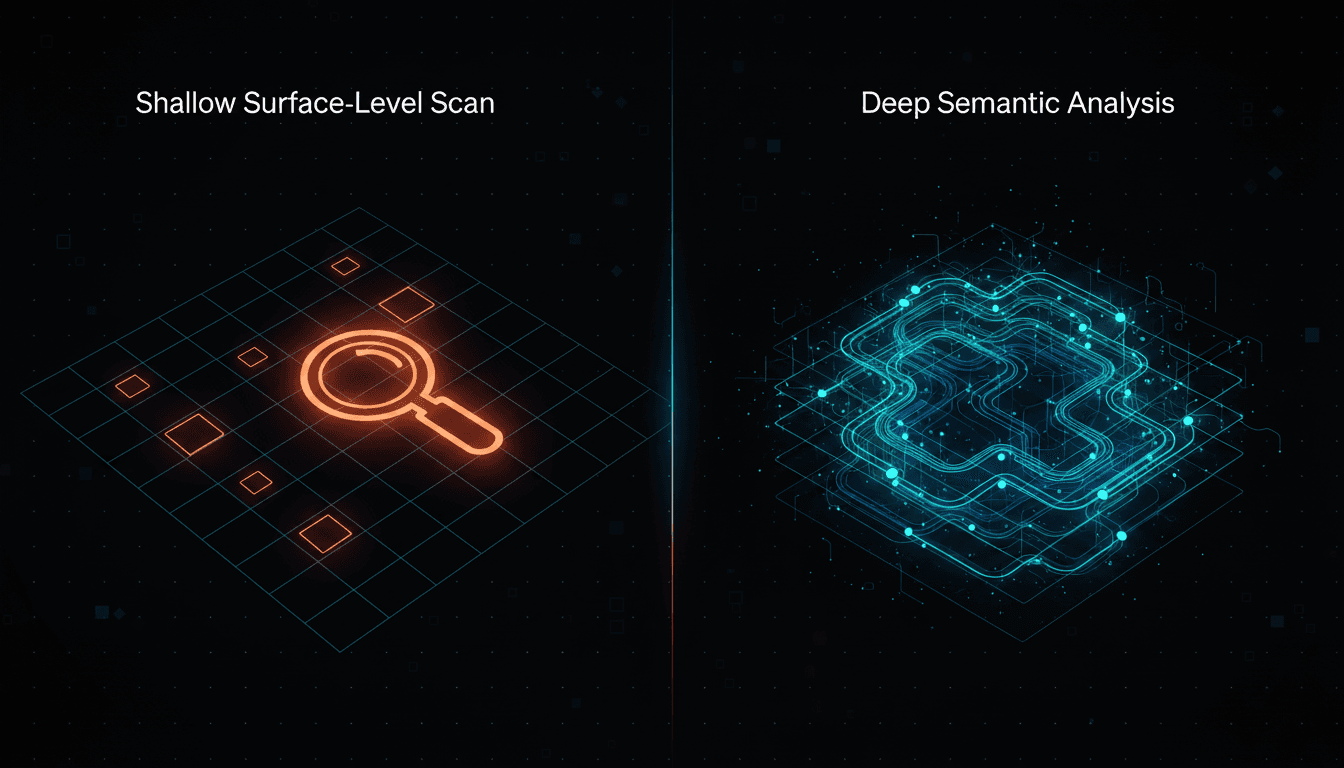
That gap has consequences. OWASP 2025 found that 100% of tested applications had some form of broken access control, while injection dropped to fifth place. The vulnerabilities causing real breaches today are semantic, not syntactic, and they require a tool that reasons about correctness, beyond simple data movement.
Gecko's compiler-accurate semantic indexing gives the AI an accurate model of how code actually behaves. The LLM reasons about security using ground truth call chains, trust boundaries, and inferred developer intent. That's why it found a three-bug account takeover chain at Cal.com that manual penetration testing missed entirely.
If accurate data flow analysis across service boundaries is what you need, try Gecko free.
Breaches happen when authorization checks get skipped somewhere in a twenty-hop call chain. Trust boundary detection matters because that's where real vulnerabilities live, not in easily-flagged injection points. Your security tooling should understand what your code is supposed to do, going beyond flagging patterns it already recognizes. If that sounds like what you need, grab time with our team to walk through how Gecko works.
Gecko Security is the strongest option for microservices because it parses API contracts (OpenAPI, protobuf, AsyncAPI) to trace data flows across service boundaries, beyond individual repos. Other tools like Snyk Code and Semgrep work well within single services but lack the semantic indexing needed to catch trust boundary violations between microservices.
If you're focused on catching injection flaws (SQL injection, XSS) with known patterns, Semgrep or Snyk Code will work well and run fast. If you need to find business logic vulnerabilities like broken access control, missing authorization checks, or IDOR across distributed systems, you need semantic analysis like Gecko that reasons about correctness, beyond simple data movement.
Gecko can: it found account takeover vulnerabilities at Cal.com and authorization bypasses at N8N that slipped past manual penetration testing. This requires understanding permission models and developer intent across multiple files and services. Pattern-based tools like Semgrep and DryRun won't catch these because they rely on matching known vulnerability signatures instead of reasoning about whether authorization logic is actually correct.
Cross-file analysis (offered by Snyk Code Pro and Semgrep Pro) traces data flow between functions in different files within the same repository, reducing false positives for injection bugs. Cross-service analysis (Gecko's approach) extends that semantic graph across multiple microservices, message queues, and API boundaries to catch trust boundary violations where user context gets dropped between service layers.
When your team spends more time triaging false positives than fixing real vulnerabilities, PoC generation becomes worth the extra time. Gecko's automated exploit generation confirms exploitability before you investigate, cutting triage effort. For rapid PR feedback on known patterns, DryRun or Semgrep's speed makes more sense, but you'll handle more false positives manually.
Gecko Security
The latest news, technologies, and resources from our team.
How Cal.com consolidated noisy security tooling into one continuous, context-aware pull request security program with Gecko.
Gecko Security
See what actually changed in the OWASP Top 10 for 2026, from merged SSRF and XXE categories to new supply chain risks and scanner coverage gaps.

Jeevan Jutla
Gecko Security uncovered CVE-2026-21894 in August 2026, an n8n authorization bypass with CVSS 8.8. See why static tools missed it and how to remediate it.
Jeevan Jutla
Security misconfiguration is OWASP A05 for a reason. Learn how deployment context determines exploitability and how to fix gaps in August 2026.
Jeevan Jutla
How do modern AppSec vendors actually compare? This July 2026 capability map covers SAST, DAST, SCA, business logic flaws, and cross-service
Gecko Security
Break down your AppSec stack: what SAST, DAST, SCA, IAST, and pen testing each see — and what they miss. Updated July 2026 by Gecko Security.
Gecko Security
Occasional updates, new content, and insights. No spam; unsubscribe anytime.




