
Company
How Cal.com Rebuilt AppSec After Going Closed Source
How Cal.com consolidated noisy security tooling into one continuous, context-aware pull request security program with Gecko.
Gecko Security
 Gecko Security10 min read
Most enterprise security evaluations come down to one question: do you need a tool that fixes what you've found, or one that finds what you're missing? AISLE excels at the first part, but without a discovery layer, it leaves you running SAST and DAST separately. For teams that want both workflows in one place, that's the constraint worth solving.
TLDR:
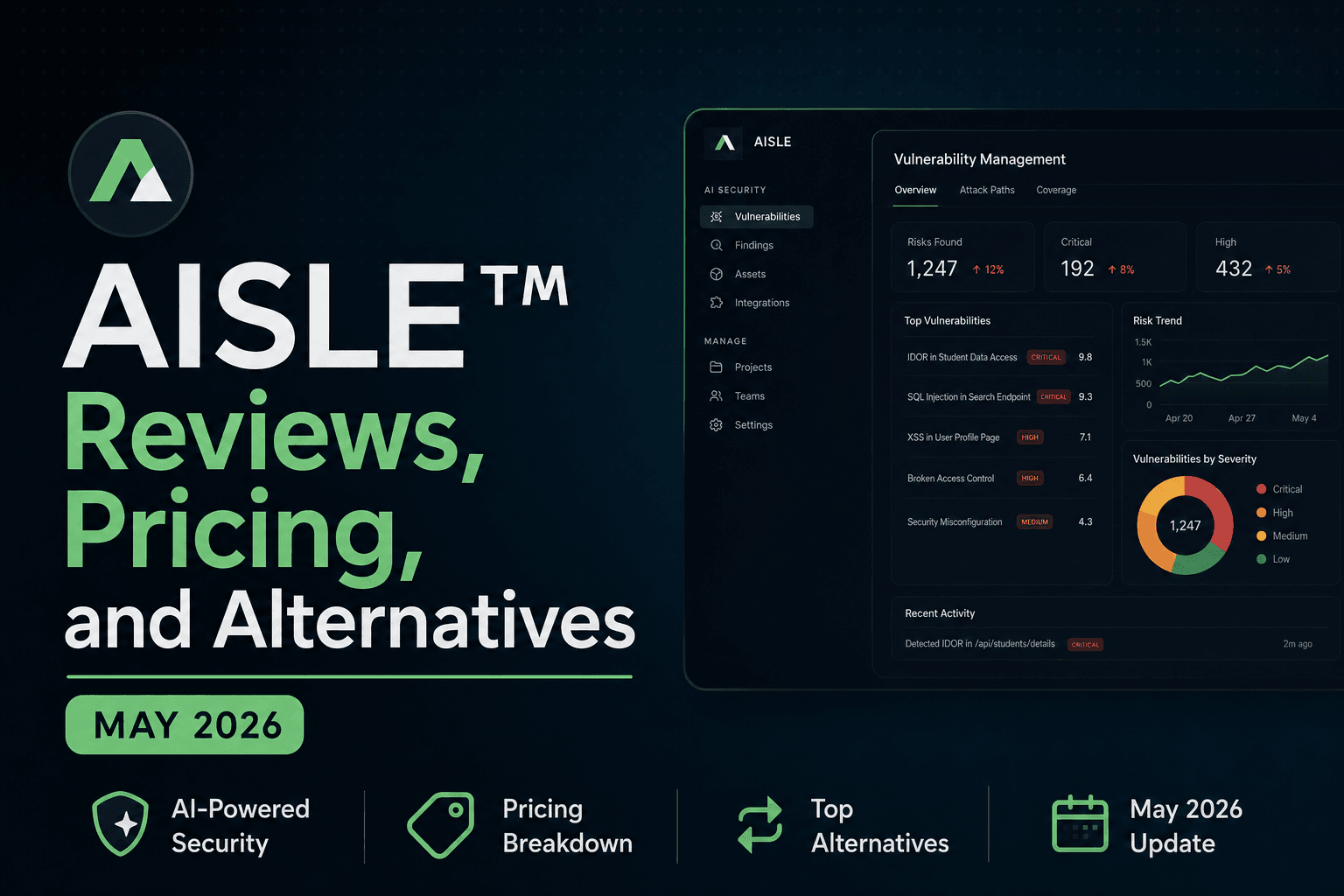
AISLE™ is an enterprise security product built around AI-driven vulnerability remediation. Where most security tools focus on finding problems, AISLE takes a different angle: it assumes you already have a list of vulnerabilities and helps you resolve them faster. The core mechanism is an AI-based reasoning system that simulates your application environment to verify whether a proposed patch actually resolves the issue before it reaches production.
The workflow runs in three steps. AISLE ingests a known vulnerability, generates a remediation suggestion, then validates that fix through its AI twin to confirm it holds without introducing regressions. That verification loop is the product's primary value.
The target audience is security and engineering teams drowning in remediation backlogs. If ticket volume is your bottleneck, AISLE solves that directly. What it won't do is surface what you haven't already found. AISLE is a remediation accelerator, not a discovery engine, and that distinction matters when you're comparing it against broader AppSec needs.
For teams with a well-structured vulnerability intake process, AISLE delivers real value. Automated remediation with pre-production validation is useful when your pipeline reliably feeds known issues into a queue. That's a narrow but legitimate use case.
The problem shows up when your discovery process has gaps, and for most organizations, it does. Business logic vulnerabilities including broken access control, IDOR, authorization bypass, and privilege escalation rarely surface through traditional scanners. They require understanding how your application is supposed to behave across service boundaries and trust layers. AISLE has no discovery layer, so it has no way to find them. It can only act on what you've already caught.
That leaves organizations running AISLE needing separate SAST, DAST, or manual pentesting on top. Two toolchains, two budgets, two integration points. For teams that want detection and remediation in a single workflow, that overhead is the actual reason to look at alternatives.
The security tooling space has matured enough that teams evaluating AISLE have real options worth considering. Below are the strongest alternatives, each suited to different team sizes, budgets, and technical priorities.
Gecko Security is an AI-powered application security tool built for engineering teams that need depth without the overhead of a traditional security program. Where AISLE focuses on workflow and compliance tracking, Gecko Security runs autonomous security research across your codebase, finding vulnerabilities that require multi-file reasoning and contextual understanding of business logic.
The core difference is in how findings get generated. Gecko goes beyond flagging known patterns; it reasons through code the way a skilled security researcher would, tracing data flows across service boundaries and identifying logic flaws scanners miss.
Teams that have outgrown checklist-driven security audits and need something that keeps pace with a fast-moving codebase tend to find Gecko's approach a better fit than more static alternatives.
Synack runs a continuous penetration testing service that pairs vetted security researchers with AI-guided workflows. Where AISLE focuses on accelerating remediation for known vulnerabilities, Synack takes on the discovery problem by deploying human researchers against your attack surface throughout the year, beyond scheduled engagements alone. The model works for organizations that need recurring offensive security coverage but lack the headcount or budget to staff a full internal red team. That said, the effectiveness depends heavily on researcher availability and engagement cycles, which means time-to-finding varies more than it would with fully automated tooling. For teams that value human intuition over speed and want findings that go beyond what scanners catch, Synack offers a legitimate middle ground between annual pen tests and always-on automation.
Here is what the core offering covers:
Semgrep is a fast, developer-friendly static analysis tool that runs pattern-based rules across your codebase. It fits teams that want lightweight security checks integrated into pull request workflows without heavy infrastructure. Where AISLE focuses on remediation velocity, Semgrep focuses on catching known vulnerability patterns early in the development cycle.
The tradeoff is scope. Semgrep's rules match syntax, not semantics, which means it works well for common vulnerability classes but struggles with logic flaws that require reasoning across multiple files or function boundaries.
Snyk is best known for dependency and container scanning, giving development teams visibility into vulnerable packages before they ship. For teams where the primary risk surface is third-party libraries and open-source components, Snyk delivers real value with minimal friction. Where AISLE assumes you have a vulnerability queue to process, Snyk helps you build one from your dependency tree.
Its code analysis capabilities exist but are more limited than its dependency scanning strength. Teams with complex business logic or microservice architectures will find Snyk covers the supply chain well but leaves application logic largely unexamined.
Checkmarx is an enterprise SAST platform with deep inter-procedural analysis capabilities and broad language support. It covers more ground than pattern-matching tools, tracing data flows across function boundaries in ways that surface vulnerabilities other scanners skip. For large organizations with mature security programs and dedicated AppSec teams to manage the tooling, Checkmarx is a serious option.
The main cost is noise. Checkmarx generates high false positive volumes by default, which means security teams spend significant time triaging findings before they can act on them. Teams without capacity to tune and manage the ruleset often find the signal-to-noise ratio works against the value the tool provides.
The table below puts AISLE head-to-head against the most common alternatives buyers evaluate alongside it. Each tool takes a meaningfully different approach to enterprise security, so the right choice depends heavily on your team's size, existing workflows, and tolerance for manual triage.
| Feature | AISLE | Gecko Security | Semgrep | Snyk | Checkmarx |
|---|---|---|---|---|---|
| AI-powered analysis | Yes | Yes | Limited | Limited | No |
| Inter-procedural taint tracking | Partial | Yes | No | No | Yes |
| False positive rate | Medium | Low | High | Medium | High |
| CI/CD integration | Yes | Yes | Yes | Yes | Yes |
| Custom rule support | Limited | Yes | Yes | Limited | Yes |
| Remediation guidance | Basic | Detailed | Basic | Basic | Basic |
| Enterprise SSO/RBAC | Yes | Yes | No | Yes | Yes |
| Pricing transparency | Low | High | High | Medium | Low |
The taint tracking row is worth pausing on. Most SAST tools track data flow within a single file or function. Inter-procedural tracking follows tainted data across function boundaries and file imports, which is where most real vulnerabilities actually live.
Gecko Security takes a fundamentally different approach to application security than AISLE does. Where AISLE focuses on structured compliance workflows and policy-driven controls, Gecko is built around AI-powered vulnerability detection that works across your entire codebase—every file and module, not only the ones you explicitly target.
The core of Gecko's engine is inter-procedural taint tracking. Rather than flagging issues file by file, Gecko traces data flows across function calls, service boundaries, and third-party dependencies. This catches the class of vulnerabilities that rule-based scanners miss entirely: the ones where a dangerous condition only becomes visible when you follow a value across five different modules.
Gecko is designed for engineering teams that have outgrown checkbox security and need something that reasons about code the way a skilled security engineer would.
If AISLE's compliance-first model doesn't match how your team actually ships and secures software, Gecko is worth a close look.
Most teams evaluating AISLE alternatives aren't looking for faster remediation, they're looking for better detection in the first place. AISLE does one thing well, but that assumes you've already caught the vulnerabilities that matter. If your current tooling misses business logic flaws and cross-service issues, speeding up patches won't close the gap. Your security stack should find what's broken before it tries to fix it. Talk to us for 30 minutes and we'll show you what semantic code analysis actually finds.
AISLE works when you already have a reliable way to find vulnerabilities, but most teams don't. Business logic flaws like broken access control and authorization bypass rarely surface through traditional scanners, which means AISLE can only fix what you've already caught. If your discovery process has gaps, you'll need separate SAST, DAST, or manual pentesting on top of AISLE, creating two toolchains to manage instead of one.
Look for tools that perform inter-procedural analysis, following data flows across function boundaries and service boundaries rather than stopping at single-file pattern matching. Check the false positive rate and whether findings include traced exploit paths with remediation guidance. If your team ships code fast, CI/CD integration that surfaces issues in pull request context before merge is worth prioritizing over tools that only run scheduled scans.
If you're running AISLE but still need manual pentesting or additional scanners to catch business logic vulnerabilities, that's a signal the workflow isn't complete. Teams that spend significant time triaging findings across multiple tools or waiting on scheduled researcher availability should consider alternatives with autonomous discovery engines that integrate directly into development workflows.
AISLE assumes you already know what's broken and helps you fix it faster through validation workflows. Gecko runs autonomous security research across your codebase to find vulnerabilities first, using AI-powered analysis that traces data flows across files and modules the way a skilled security researcher would. The difference is discovery versus remediation—Gecko finds the business logic flaws that never make it into AISLE's queue.
Gecko Security
The latest news, technologies, and resources from our team.
How Cal.com consolidated noisy security tooling into one continuous, context-aware pull request security program with Gecko.
Gecko Security
See what actually changed in the OWASP Top 10 for 2026, from merged SSRF and XXE categories to new supply chain risks and scanner coverage gaps.

Jeevan Jutla
Gecko Security uncovered CVE-2026-21894 in August 2026, an n8n authorization bypass with CVSS 8.8. See why static tools missed it and how to remediate it.
Jeevan Jutla
Security misconfiguration is OWASP A05 for a reason. Learn how deployment context determines exploitability and how to fix gaps in August 2026.
Jeevan Jutla
How do modern AppSec vendors actually compare? This July 2026 capability map covers SAST, DAST, SCA, business logic flaws, and cross-service
Gecko Security
Break down your AppSec stack: what SAST, DAST, SCA, IAST, and pen testing each see — and what they miss. Updated July 2026 by Gecko Security.
Gecko Security
Occasional updates, new content, and insights. No spam; unsubscribe anytime.




