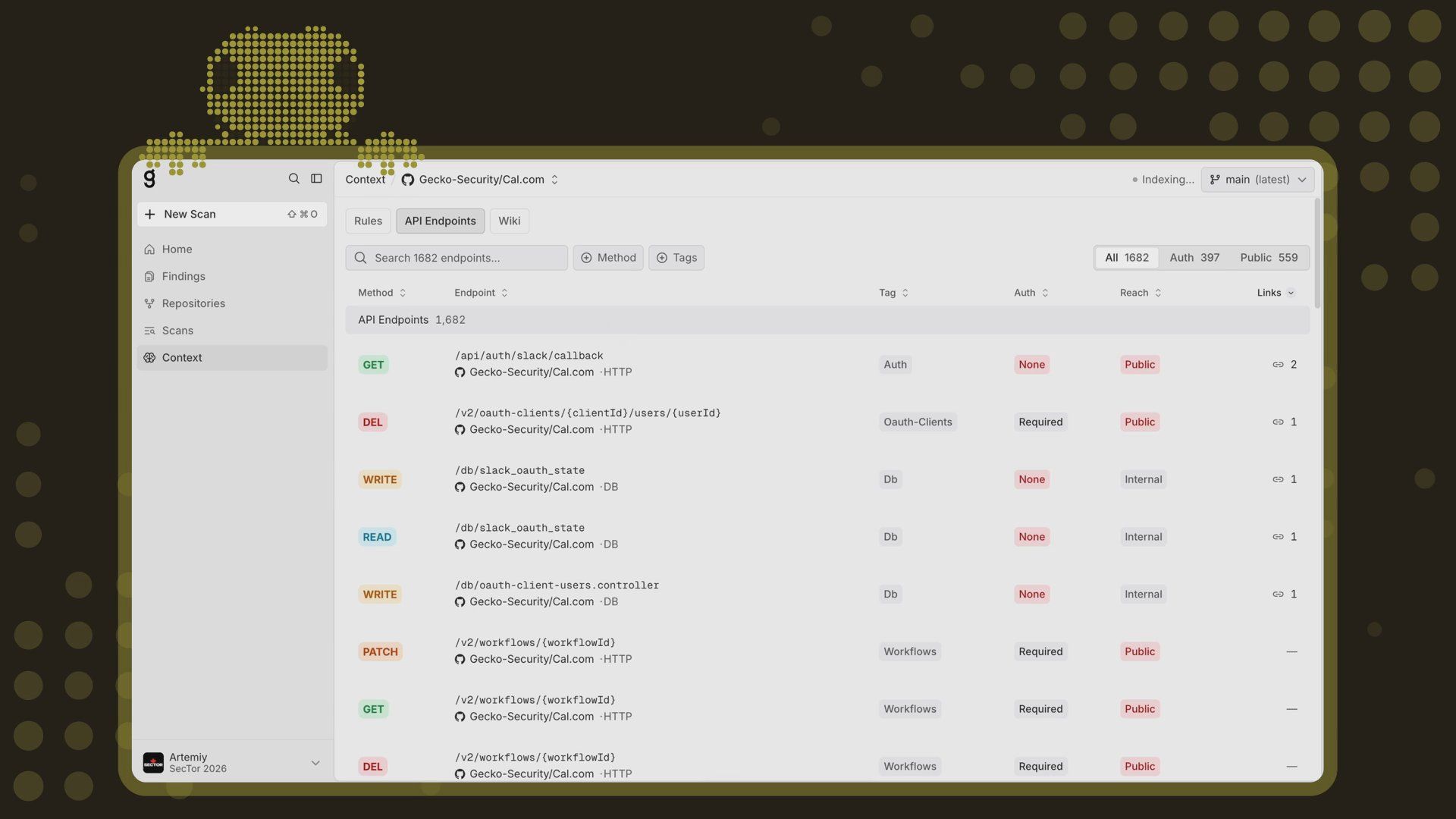
Connect
Connect Your Code, Scan on Every Commit
Point Gecko at your repositories and it scans them continuously, or on the schedule you set. There is no window to wait for and no quarterly cycle to plan around.
Code scanners hand you a longer list. Gecko reasons across your code, infrastructure and design docs, clusters findings by the decision that created them, and fixes the class for good.
One root-cause fix ends the variants, the re-tickets and the repeat bounty payouts, and gives your engineers back the sprints they spent re-fixing the same flaw.
“Classes eliminated this quarter” is a number leadership can act on, not another slide of activity metrics.
Gecko reviews every commit at pen-test depth, so flaws surface in the code, not five weeks after release.
Evidence accumulates as you ship, so the audit trail is already written by the time anyone asks for it.
Connect
Point Gecko at your repositories and it scans them continuously, or on the schedule you set. There is no window to wait for and no quarterly cycle to plan around.
Understand
Gecko builds a semantic graph of your application and threat-models it, so every finding is traced back to the design decision behind it. Fix that decision once and the guardrail holds on every commit after.
Scale
Security review is the checkpoint velocity dies at. Gecko meets developers in the pull request with a fix, written in the style of the codebase.

“The vulnerabilities that keep CISOs up at night are business logic flaws and multi-step attack chains most tools can’t see. That’s where breaches happen. Gecko is built to find them.”

Jon Raper
CISO, Chevron

“One tool that gives us great results from a full scanning perspective, and every single pull request that goes in, we know is protected.”

Keith Williams
Head of Engineering, Cal.com

“Gecko found business logic vulnerabilities we’ve only ever been able to get from manual code reviews, and the false positive rate is the lowest we’ve seen from any scanner”

MD of Security
F500 Financial Institution
How Gecko is different, and what that means in practice.
Connect a repo and compare Gecko’s output with what you have today.
Three things Gecko does differently. Each one is a consequence of the same decision: understand the application first, then look for what can go wrong in it.
Attackers Think in Chains. Now You Do Too.
Gecko runs attack path analysis across your findings, modeling them as connected routes rather than a ranked list, so the dangerous combinations surface before someone else finds them.
Your Policies, in Your Words. Held Everywhere.
Write a rule in plain English, like “every public endpoint must be authenticated”, and Gecko enforces it across every repo and language.
Understand Every One of Your Repos.
Gecko builds a living map of every repository: what it does, its architecture, its endpoints, how services connect. Six people can hold a six-thousand-repo estate in their heads.