Ephemeral
Ephemeral by Design
Every scan runs in an isolated, short-lived sandbox that is destroyed the moment it completes; your code is never stored at rest.
Six steps from connecting a repository to a merged fix, with nothing hidden in between.
Six steps. No black box.
Step 1
Sign up with email or GitHub, connect GitHub, GitLab, Bitbucket or Azure DevOps, and pick the repos you want covered. Gecko takes only the metadata it needs; nothing heavier. Invite your team, or don’t yet. You can start your first scan in the same minute you sign in.
Step 2
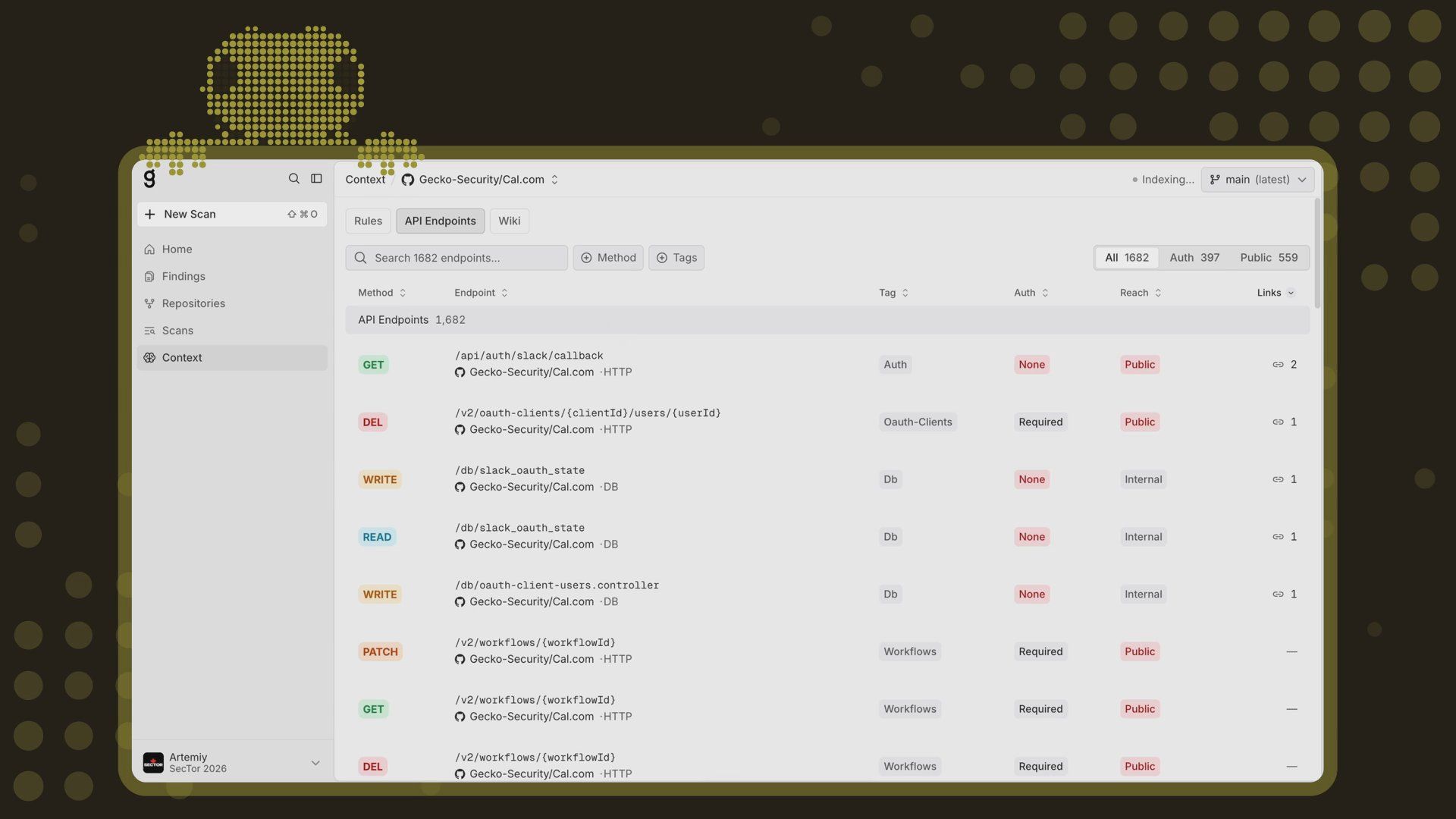
Before it hunts anything, Gecko builds a wiki for every repo: what it does, how it’s architected, which endpoints exist and which are publicly exposed, how services connect across repositories. Your team gets a living map of an estate nobody fully holds in their head. Gecko gets the understanding every finding will be judged against.
Step 3
Your code is cloned into an isolated sandbox that exists only for this scan. Gecko maps every path an attacker could take, then sends a dedicated agent down each one, carrying full context about your application. Deliberately compute-heavy, because that’s what keeps the signal high. Findings are checked, deduplicated and compared against previous scans. First results typically land within the hour. The sandbox is destroyed on completion.
Step 4
Every finding arrives with the data flow from entry point to impact, what an attacker needs, how to reproduce it, and the fix. Findings that share a root cause are grouped, so you fix the decision once instead of the symptoms one by one.
Step 5
Three levels of autonomy, and it’s your choice how to fix. Create tickets in Jira, Linear, ClickUp or Shortcut and assign them to people. Have Gecko open the pull request itself, fix included, written in your codebase’s style, with your chosen reviewer assigned. Or go fully agentic: pull findings into Claude, Codex or Devin over MCP and let your AI workflow fix them. When the ticket closes or the PR merges, Gecko verifies the fix and learns how you resolved it.
Step 6
PR scanning watches every pull request from then on. Each new commit is re-checked, so you merge knowing the vulnerability is gone rather than hoping. The guardrails from every class you’ve eliminated are enforced on every commit. Your open count trends down; your codebase keeps growing securely.
Integrations
Gecko connects to your repos, pipelines, and trackers with native connectors for Claude, Codex, and any MCP server.

Gecko indexes your code with language-server-grade resolution rather than pattern matching, so it knows what every name and call actually refers to, across repos and across languages. On top of that graph it threat-models your specific application, builds vulnerability test cases from your architecture rather than generic rules, and validates each candidate finding before you ever see it. If you want to go deeper than this page, the docs are open, and so is the free trial.
Ephemeral
Every scan runs in an isolated, short-lived sandbox that is destroyed the moment it completes; your code is never stored at rest.
Zero-Trust
We’re SOC 2 compliant, and our full posture is documented at trust.gecko.security. Access to repositories requires secrets our database never holds, so no single compromised system can reach your code.
On-Prem
For teams that need it, we deploy hybrid or fully on-premise, where you own the compute, the logs, and everything else.
What Gecko touches, how long it takes, and what happens when you disagree with it.
Connect a repo now, or book thirty minutes and we’ll walk you through it on your own code.